Thursday, October 7, 2021

The Best Man: IFcomp 2021

The Best Man is a choice-based story by Stephen Bond that was entered into IFcomp 2021. It’s phenomenally well-written, which made it a challenge to enjoy.

The Best Man is initially told from the perspective of Aiden. He has been asked to stand in for the best man at Laura’s wedding, and that forces him to confront unresolved feelings about their past relationship. Their story is vivid and uncomfortable.

For the first few chapters, it looked like the author was a “Nice Guy” who had created an autobiography to process events from his own life. I was concerned that I’d spend the entire time watching someone wallowing in destructive behavior.

Then the perspective shifted, and I realized that the author wasn’t a self-pitying doormat — just unnaturally good at creating narrative voices. Laura’s wedding is viewed from several perspectives, and each one them feels distinct and internally consistent.

The Best Man also uses some clever writing and supporting mechanics to handle its character changes. Colored hyperlinks indicate that the reader has assumed a new perspective, while Aiden’s eye-catching white suit allows readers to track him through the scene.

The story is advanced with dialogue choices, and those decisions are referenced in later passages. I couldn’t tell whether it meant that I had any control over the narrative, but I managed to get Aiden to a final state that seemed healthier for him.

It’s possible that Laura’s wedding could have ended quite differently, but I lack the endurance that would necessary to find out.

Wednesday, October 6, 2021

Unfortunate: IFcomp 2021

Unfortunate is a parser-based puzzle by Jess Elizabeth Reed that was entered into IFcomp 2021.

I loved the premise of this game — it puts you in a short, repeatable scenario as an accretive PC (something similar was used for last year’s The Copyright of Silence), and you use your knowledge to make predictions as a fortune teller.

After three runs through Unfortunate, you have enough information for completely accurate predictions. It poses an interesting question: should you predict misfortune and then passively watch it unfold? Or do you want to take action for more positive results?

Unfortunate is an ambitious work, and that ambition may have created some implementation issues. I found exits that became inaccessible and descriptions that referenced non-existent objects. And I couldn’t predict misfortune and passively watch the results, because two characters completely disappeared from the game.

I would have appreciated it if Unfortunate set out its initial expectations more clearly; I approach puzzles differently when it’s clear that they’ll be a repeating sequence. This entry was fun, but more playtesting would have improved the experience.

Tuesday, October 5, 2021

Smart Theory: IFcomp 2021


Smart Theory is a short comedy by AKheon that was entered into IFcomp 2021. It encounters one of game design’s common problems: How do you simulate an unpleasant experience without driving away your audience?

Last year, Savor described repeated, excruciating pain. Accelerate expected you to actively participate in atrocities. And this year, Smart Theory wants you to endure a training session that blends all the worst aspects of motivational seminars and religious cults.

The writing is smoothly implemented and effective. It was fun to see how the “first rule” of Smart Theory was applied in the story. This entry works as a kind of power fantasy — you can mock transparent nonsense and criticize sloppy thinking.

However, the whole thing felt too plausible. A shamelessly inflated sense of self-importance is part of every management training course; they all discuss overpriced-but-revolutionary new paradigms. Attempting to debunk their transparent nonsense is just as futile inside Smart Theory as it is in the real world.

If you view it without irony, Smart Theory is interchangeable with a lot of the overpriced self-help literature that currently exists. That can be read as a declaration that there are no new ideas in this space, but it feels simultaneously correct and tedious. 

Monday, October 4, 2021

The Last Night of Alexisgrad: IFcomp 2021

The Last Night of Alexisgrad is a unique experience created by Milo van Mesdag for IFcomp 2021.

This entry is meant to be explored by two players who communicate with each other outside of the story. The strong characterization of each role (the Dictator and the General) sets a different tone for each perspective, offering vastly divergent interpretations from the same sequence of events.

It’s also a very lopsided experience. One player starts from a position of strength, and the other gets the rough end of the pineapple. If Last Night of Alexisgrad meant this to be an intentional message about different types of government and their relative strengths in a crisis, I ignored it.

I was fascinated by the unfolding meta-game in Last Night of Alexisgrad, which asks whether the player/reader wants to consider their own motives and the motives of their partner as something separate from their respective characters. It was tough to avoid sharing my reactions while the story unfolded. 

However, I felt much more distant from the story during the direct interactions between General and Dictator. As the players pass messages outside the game, their impassioned arguments and pleas for mercy get reduced to flat combinations of letters and numbers.

This entry was fun, and I can only imagine the work that was necessary to correctly implement different branches of the narrative while keeping them hidden from half the audience  the hard work paid off! 

I was entertained by the descriptive writing and the historical depth of The Last Night of Alexisgrad.

Saturday, October 2, 2021

The Daughter: IFcomp 2021

The Daughter (alternately capitalized as “The daughter” in its IFcomp ballot listing) is a choice-based story created by Giovanni Rubino for IFcomp 2021.  

I had difficulty engaging with this work because of implementation issues. The pale gray text was difficult to read, most of the passages included spelling errors, and then it ended abruptly. (Right after I asked to be pointed to my room, everything stopped.)

The Daughter’s blurb makes it sound like The Children of Men meets The Eyes of Heisenberg, but its focus was uneven — some details were described exhaustively while other information felt like it was missing. This might have been translated from another language, which could explain some of its unusual phrasing and descriptions. 

If not, there were some bold style choices that failed to resonate with me.

Overall, I couldn’t find enough relatable context to understand the forces at work in The Daughter’s far-future setting. Yes, there were some jokes about the broken culture of the twenty-first century, like our fixation on true crime podcasts, but they were used to emphasize differences, not to build empathy.

The Daughter might be waiting to be discovered by the right audience, but at the moment I think it could be improved with more thoughtful editorial decisions.

My Gender Is a Fish: IFcomp 2021

My Gender Is a Fish is a choice-based work that Carter Gwertzman entered into IFcomp, and it is beautiful.

Maybe it’s not technically beautiful — MGIAF uses Twine’s basic Sugarcube format with default font colors — but I really enjoyed the writing. Your gender gets stolen by a magpie, and you make a sequence of choices on the path to reclaim it. Each playthrough sees the same choices, but the story is short and the text changes enough to make it worth playing more than once.

I'm reluctant to call My Gender Is a Fish an allegory. For one thing, it doesn’t take itself seriously. Also, I’ve never clearly understood what makes an allegory. But that feels like a good fit for this entry's affirmative message about being okay with ambiguity.

My Gender Is a Fish asks thoughtful questions and makes sharp comparisons: How much of your life is tied to your gender identity, and what would you do without it?

Saturday, August 28, 2021

IntroComp 2021: Final Girl 2.0

Final Girl 2.0 is a choice-based adventure from Hanon Ondricek that was entered into IntroComp 2021.

This entry starts by referencing the Final Girl convention from horror movies, showing that the author knows how these films work. It also suggests that the reader is equally clever. It must be simple to avoid making the dumb mistakes that you see characters making in these stories, right?

Final Girl 2.0 argues that it’s not so easy when you’re the one being stalked by a homicidal maniac. Suspenseful background music and timed events work together to provide dramatic tension while you’re fighting for your life.

This entry's clever design choices struck a balance between keeping the game accessible and maintaining a sense of urgency. I particularly liked how some links had to be selected in a specific order, which felt similar to performing a challenging sequence of actions in the real world.

The resulting experience is like a magic trick. Close inspection of the text is the only way you’ll survive, but the story’s atmosphere prevents you from loitering and inspecting things too closely.

I reached an ending on my first playthrough — there are clear signals guiding the player to safety — but when you go back to experiment with some of the other options, it’s clear that some of the illusions were meant to be dispelled.

I want to see this developed into a full game. Final Girl 2.0 already suggests a lot of possibilities in its current state.

Friday, August 27, 2021

IntroComp 2021: Gender Exchange

Gender Exchange is a work by nDev that was submitted to IntroComp 2021.

This entry is a visual novel, which means I’m not going to be the best judge of its strengths — everything I know about VNs has been written by other people.

Gender Exchange is the story of a boy who loves Japanese culture so much that he’ll pretend to be a girl for a chance to study there. It’s also an unbroken narrative with no choices for the reader. (Maybe that will change if it’s developed into a full game?)

The plot seems suitable for the VN format, although I was a little surprised that it didn’t rocket straight into NSFW territory. Cross dressing is central to the story, but it’s not used to describe any sexual thrills. And horny people make suggestive remarks, implying devious plans, but the narrator maintains an innocent, unapologetic enthusiasm for Japan and Japanese culture.

I respected how the protagonist accepts himself, and his love of Japanese culture, in an unfailingly positive way. He endures verbal abuse because people dismiss his hobbies as weird. He makes some cringe-inducing choices in pursuit of his dreams. And nevertheless, he persists.  

Switching genders to attend high school in Japan is not something that I would enjoy. But the narrator’s excitement is so earnest that I’m happy he enjoys it.

Thursday, August 26, 2021

IntroComp 2021: MISSION UNKNOWN

MISSION UNKNOWN is a choice-based story by Carl Muckenhoupt that was entered into IntroComp 2021.

This story created a nuanced, well-defined atmosphere in a short period of time. The experience of poking around in a file directory showed how different mechanics could provide variety in a full game, but it mostly used basic text choices in a way that didn’t intrude on the narrative.

I was struck by the elegant way handling of the player’s decision to begin the adventure. It reminded me of an earlier discussion about implementing the Hero’s Journey in video games — the “Refusal of the Call” needs to be handled carefully, and MISSION UNKNOWN was an example of using that decision to define the stakes involved and reflect on the protagonist’s self-perception.

It would be interesting to see how this develops into a complete game. 

The prologue used familiar themes and recognizable conflicts to make its science fiction setting more relatable. It showed a narrator who whose workplace has gradually transformed into something alienating and uncomfortable. And then it abandoned all that for a voyage into the unknown.

Sunday, August 15, 2021

IntroComp 2021: Resist

Resist! is a choice-based adventure from Damon Wakes that was entered into IntroComp 2021.

This entry uses a minimalist interface — you decide whether to tap a key before the timer runs out — like the one in Move On, the IFComp 2020 work from Serhii Mozhaiskyi. Although the mechanics are similar, Resist! uses a different tone to explore a separate genre.

Wakes is a skilled writer who starts this story with familiar scenes from zombie movies. This time, the player is part of the undead horde, and the narrator puts a different perspective on the violence and bloody mayhem that accompanies their rampage.

On the one hand, text effects and strong writing do a good job of conveying emotion and character. The design choice to use timed text fits with the theme of the game. The player gets carried along by the narrative and chooses when to actively oppose it.

On the other hand, it’s still timed text. Settings are available to control the speed, but there’s no option to disable it entirely.

This entry was polished, entertaining, and short. Although I’d like to see a longer version, I also think it would be challenging to maintain an engaging experience over the length of a full story, especially when all the decisions have to be steered with binary yes/no choices.

(For the record, “challenging” is not the same as “impossible,” and I think that Wakes is skilled enough to pull it off.)

Wednesday, August 4, 2021

Daddy's Birthday: ParserComp 2021


Daddy's Birthday is a text adventure from Jonathan that was entered into ParserComp 2021.

I chose to take this entry at face value: a sweet collaboration where an 8-year-old’s work of interactive fiction has been implemented by a skilled programmer.

Emily Short described this approach to game development as writing the through-line first, starting with an ideal walkthrough and then building out a larger experience from there. Daddy’s Birthday includes an extra feature that lets people read their original walkthrough to see what the writer had in mind.

It’s interesting to see the mainstays of interactive fiction interpreted by a younger author. While there are familiar mechanics at work, some design choices have gone in novel directions. (The house is laid out along diagonals, with most of the passages heading northwest and southeast.)

Some of the writing is understandably awkward — one description says “A few rooms go different directions, but you decide to go down the stairs” when a different phrase might have worked better — but that’s largely because the implementation remained faithful to the source material.

The complete project feels like a thoughtfully negotiated compromise. It’s an interactive experience that maintains the spirit of its original ideas, and I hope that the creators continue to build on those ideas to explore new frontiers in game design.

Sunday, August 1, 2021

Foreign Soil: ParserComp 2021

Foreign Soil is a text adventure from Olaf Nowacki that was entered into ParserComp 2021.

This entry starts strong, with effective writing that clearly establishes the main character’s situation and how they feel about it. Narrative details provide hints about a backstory, and environmental threats offer a sense of danger.

A substantial part of the gameplay involves figuring out what to do next, which makes it tricky to discuss Foreign Soil in a way that doesn’t ruin the experience. I liked how the environment changed around me, creating new locations and updating descriptions as various objectives were completed.

I also appreciated how in-game deaths were handled — the setting is supposed to be harsh and unforgiving, so it needs to show appropriate consequences for risky decisions. The game struck a nice balance that encouraged experimentation while showing how dumb choices will get you killed.

Unfortunately, I got stuck in the middle of the story because I wasn’t willing to take enough risk. I knew where I was supposed to advance the story, but I was reluctant to try different commands that might move things along. After overcoming that hurdle, things flowed logically through the endgame.

Foreign Soil was fun, and my only complaint is that I wish it was a longer experience.

Thursday, July 22, 2021

Spring Thing: Lady Thalia and the Seraskier Sapphires


Lady Thalia and the Seraskier Sapphires is a choice-based work by E. Joyce and N. Cormier that was entered into Spring Thing 2021. (Joyce has a previous creation, What the Bus?, that was in IFComp 2020.)

This is an intricate heist story where the player navigates branch-and-bottleneck structures to conduct a series of thefts. Strong writing supports the narrative while disguising the code running behind the scenes, and it feels like there are multiple ways to achieve your objectives.

Most of the player’s time is spent Getting People to Do What You Want — the main character flinches at describing it with a crass term like “manipulation.” It feels like a combat system for conversation (Convat? Combersation?), and success reveals useful information. In the evenings, that information helps the next heist run smoothly.

Lady Thalia is confronted with a few puzzles during her adventures, but players who find them too difficult can use alternate solutions. I especially liked the scoring mechanism, which is embedded in playful banter between friends.

Additional excitement comes from the interactions with Thalia’s nemesis, a consultant with Scotland Yard. (Thalia’s pseudonym comes from muse of comedy, and her pursuer is regularly referred to as Melpomene.)

The overall enjoyment of this work is going to depend on personal preference; I may not be the world’s biggest fan of cucumber sandwiches, high tea, or drawing room repartee. However, those sequences were nicely offset by nighttime skullduggery and daring escapes from the law.

Tuesday, July 20, 2021

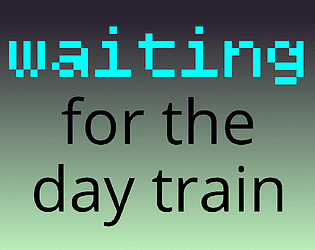
Waiting for the Day Train: ParserComp 2021


Waiting for the Day Train is a text adventure from Dee Cooke that was entered into ParserComp 2021

This story establishes its stakes immediately — the early text and graphics show what will happen if you miss the Day Train. Then it transitions into the game’s main environment, which is serene and natural, but the introductory sequence has added a feeling of tension that keeps things moving.

Although the train platform is only a short distance away from the player’s starting point, not much time is left before the train departs. The countdown felt like it was managed effectively, leaving me with just enough time to work through challenges while still feeling like it would be a close call.

Waiting for the Day Train presents a few puzzles in a small, well implemented environment. Descriptive details add depth without confusing or distracting from the major challenges. The strength of this work comes from its simplicity.

Sunday, July 18, 2021

Spring Thing: Misty Hills

Misty Hills is a choice-based work by Giuliano Roverato Martins Pereira that was entered into Spring Thing 2021.

The player is returning home after completing a quest “off camera,” and a clock on the side of the screen tracks the time while they wait for the next tram.

The author’s note describes it as a chill game that players are meant to enjoy at their own pace, and the implementation supports that experience. (Misty Hills also received an audience award for being the “most relaxing” Spring Thing entry.)

I enjoyed how Misty Hills provided a low-stakes opportunity to explore a fantasy environment that was engaging mix of the familiar and the magical. Although I wanted to catch the next tram, it didn’t feel like a life-or-death challenge that determined the fate of the world.

I also appreciated how there weren’t any unpleasant surprises or unfair traps. These structures have been described as confirmation-required choices — you might end up missing the tram, but it will be the result of deliberate decisions that you made while exploring.

Misty Hills is an inviting, complicated world that holds the potential for (mis-)adventure without antagonism.

Wednesday, July 14, 2021

Snowhaven: ParserComp 2021

Snowhaven is a text adventure from Tristin Grizel Dean that was entered into ParserComp 2021

This entry used effective storytelling to deliver a complete experience in a small set of locations. The player uses simple objects to complete some basic tasks, but relationships and memories add narrative weight to the proceedings.

Snowhaven’s story strikes a balance between important physical details and the emotional components that motivate the main character. I appreciated its clean, efficient writing.

Black-and-white graphics make effective contributions to the story’s wintry atmosphere without becoming a distraction — subtle animations in a few locations reinforce the impression of frozen stillness everywhere else. I initially thought that one challenge required a solution that could only be found in the game's images, but some later digging uncovered alternative clues elsewhere in the text.

A few parts of Snowhaven felt like the infamous “kill the dragon with your bare hands” sequence from Adventure, and I’ll be interested to see how a wider audience receives them. Had I cleverly guessed the correct sequence of phrases to solve a series of under-clued puzzles? Or were these obvious solutions that shouldn’t need to be telegraphed? (If it’s the latter, then I salute some brilliant design work that made me feel good about myself.)

This entry offers an atmospheric experience that focuses less on puzzles and more on details. Overall, it’s a short, polished story that was satisfying to complete.

Wednesday, June 30, 2021

Spring Thing: Sunny’s Summer Vacation

Sunny’s Summer Vacation is a choice-based work from Lucas C. Wheeler that was entered into Spring Thing 2021

It chooses a premise (“You are a Corgi on a sandy beach”), and it commits. As that Corgi, you accompany your humans on a summer vacation. 

The player’s role is plot-adjacent; other characters come to terms with a divorce while the protagonist offers emotional support. Each day offers a new chance to play vacation-themed minigames, like volleyball and sandcastle building, which are meant to create some happy memories for the humans during a difficult time. 

Sunny’s Summer Vacation is described as a spiritual successor to Adventures with Fido, and Wheeler’s enthusiasm for Corgis gives both works an unapologetic charm. This entry improves on its predecessor by focusing on a smaller set of characters and a consistent story. 

Although the setting was entertaining, I had difficulty enjoying a few of the minigames. I had read similar concerns about Adventures with Fido — it felt like some experiences were designed by asking “Could this be programmed?” rather than “Would this be fun?” 

Sunny’s Summer Vacation is a solid work from an author who is dedicated to improvement, but additional feedback from thoughtful playtesters might have made it even stronger.

Sunday, June 27, 2021

Spring Thing: A Blank Page

A Blank Page is a choice-based work from Edu Sánchez that was entered into Spring Thing 2021.

This entry is described as a story about creative block. It’s short and relatable, but I approached it with some skepticism — can such an experience really be created on demand? 

The answer was a pleasant surprise. You cycle through a narrator’s creative routine, choosing different activities that might lead to the start of something meaningful. It’s presented in black text appearing on a white background, providing a mix of links that either cycle through words or advance to a new passage.

(Unfortunately, I noticed some minor typos and spacing issues that were more prominent due to the story’s clean presentation. On the other hand, the author is based in Spain, and their English is much better than my Spanish.) 

Intentional style decisions establish that this is not a joke entry. It’s a deliberately crafted experience offering a sense that something will happen eventually, after you experiment with the available options. These choices might be mere procrastination, or they could be an important part of your creative process.

I enjoyed the conclusion of A Blank Page because it felt like an authentic ending to the journey. Or at least it made a good place to stop. 

Wednesday, June 23, 2021

Spring Thing: Journey to Ultimate Fightdown

Journey to: Ultimate Fightdown! is a choice-based work from Havilah McGinnis that was entered into Spring Thing 2021.

Fightdown! takes place inside an RPG that loses its “connection” right before the final showdown. The experience is like being on a movie set when the cameras stop rolling, and every character has something to say. 

This is a choice-based story where the player talks with other characters while they wait for their connection to be restored. Minor puzzles are involved in negotiating and trading items among the cast, which changes how the ending unfolds. 

I enjoyed how Fightdown! explored the relationships between its different characters. The story blends stock fantasy roles with recognizable Hollywood stereotypes to create entirely new personalities — and then it encourages the player to ask them what they think about each other. 

Does the embittered burnout want the hard-working underdog to fail? What does the overachiever think about a coworker acting like a role is beneath them? Text effects are judiciously applied to convey some phenomenal sarcasm. 

Overall, this felt like an approachable, safe-for-work version of Midnight, Swordfight. (It also reminded me of Janitor, asking the player to work behind the scenes for another person’s enjoyment.) Playing through to the end unlocks enhancements that make it easier to explore different branches of the story.

Tuesday, May 18, 2021

Getting Started with McDonalds Theory

None of my projects could have been completed without the McDonald’s Theory. It’s one of the most useful pieces of advice I’ve encountered. As Jon Bell puts it: 
“There’s no defined process for all creative work, but I’ve come to believe that all creative endeavors share one thing: the second step is easier than the first. Always.” 
Bell’s theory makes that first step less difficult — when you start with the worst possible option, it’s easy to improve from there.
 
Good creative work involves making gradual improvements to an initial idea. That’s tricky when your inner critic won’t let you commit to something, but it’s simpler when you commit to making that idea terrible. 

Once you’ve declared that the plan is to eat at McDonald’s, it becomes much easier to make better plans. 

Jon Ingold made a similar observation when he discussed his approach to writing games with meaningful choices. “No one has the time to be brilliant all the time,” he said. “You need to just get it down, and get it better.” 

After you’ve gotten it down, the terrible idea might look too terrible. Things can seem so dismal that there’s no hope for improvement. That’s when it’s important to remember that everyone has difficulty judging the value of their own work. 

Authors never know how their writing will be received. Editors always overlook typos in their own material. Charles Darwin thought he was “the most miserable, bemuddled, stupid Dog in all England,” although other scientists disagree. 

It’s impossible to tell whether you’re working on something amazing or something awful — Kara Cutruzzula spent a year setting herself up for failure and described it as a process where you “vacillate between extreme narcissism and extreme self-loathing.” 

The narcissism helps you create things, and the loathing helps you improve them, but the risk of public failure is the only way to learn what other people think. 

The good thing about failure is that it presents opportunities to learn and improve. Cutruzzula ultimately viewed every failure as a brick. “As long as you keep laying bricks,” she wrote, “you will build something.” 

The key is to learn from each failure and move on to the next project. To start that project, you need to come up with an idea. That’s when it’s useful to return to the McDonald’s Theory.

 
Photo by Niklas Rhöse on Unsplash.