Showing posts with label game design. Show all posts

Sunday, November 2, 2025

Meaningful divides

I largely think “generational divides” are bullshit — there’s often more variation within generations than between them.

On the other hand:

A Bluesky post asserting that the real generational divide is people who refuse to watch a video if it could be an article versus people who refuse to be an article if it could be a video.

Here’s the thing: I experienced physical pain sitting through an hour and a half of video discussing Vampir: Kyuuketsuki Densetsu. (Okay, I ran the video at 2x speed, but it still ended up being about 30 minutes longer than necessary.) I wish it was an article, because I could have skimmed the text a hell of a lot faster. 

After enduring the video, I'm now writing out the reviewer’s assertion that Vampir benefits from an inverse Harvest Moon mechanic:

  • It takes place in settlements full of characters who have daily routines.
  • You visit townspeople to strengthen your relationships with them.
  • Each relationship can only be strengthened once a day.
  • As your relationships advance, you learn different pieces of each character’s story.

(This is also something you see in Story of Seasons, Stardew Valley, or any other relationship-building title.) The guy narrating the YouTube video was captivated by the way Vampir inverts this trope — as a vampire, you’re working to erase everything that makes these people human. Your character patiently builds these relationships and learns backstories as part of a calculated effort to amass an army of mindless thralls. 

Meanwhile, your computer-controlled opponent is running around the map and trying to win people over to his own cause. It’s notable that while the reviewer felt that the experience was bland and tedious, the game's character-driven narratives made a strong impression. I had hoped to pick up more lessons in game design from that video, but I'll settle for seeing how good storytelling can shore up mediocre gameplay.

Elsewhere in bland and tedious, I read two books in October: Greg Bear’s Moving Mars and Terry Goodkind’s Running with the Demon. Neither one was particularly rewarding. 

I was hoping that Moving Mars would be more along the lines of Blood Music or Steel Beach (although it turns out that John Varley wrote Steel Beach; I'm not sure why I misremembered the author as Bear). Moving Mars ended up being more of a political thriller? Lots of factional maneuvering to develop and control a technology that is offscreen for most of the book. The text was divided into thirds, and I wish the story began with the final third, where they’re actually applying the technology and making things happen. 

I never got into Terry Goodkind’s Shannara books —several people recommended them when I was growing up, but I found them overstuffed with description and not very interesting. I always wondered whether I had tried reading them too young. Now that I’m older, I know that's not the case; I still find them overstuffed with description and not very interesting.

Edited to note that an observant reader pointed out how I confused Terry Goodkind with Terry Brooks. It was Brooks who wrote the Shannara series, but that still didn't make Running with the Demon very interesting.  


Image credit: hans/ Pixabay   

Saturday, June 22, 2024

Truck Quest: The cutting edge of 201X

Black and blue strings of ones and zeroes that suggest computer code.

When Donald and I started working on Truck Quest, we needed a design for Samson, the eccentric loner who actively opposed surveillance capitalism. It was 2018, more than 10 years since Anonymous made headlines for opposing the Church of Scientology. “Mr. Robot” had also been around for almost half a decade, which gave us some ideas about what Samson would look like and who he would be connected to.
  
Although the Guy Fawkes mask was an obvious idea, it wasn’t a good fit for our paranoid activist. There’s no way his efforts to undermine exploitative globalization would use a mass produced commodity that generated revenue for a major entertainment conglomerate! Samson might have had some unusual opinions about how society should work, but he wasn’t an idiot.

Instead, we looked at some of 2018’s cutting-edge solutions for remaining unrecognized: 
Samson ended up with several different disguises to remain incognito.


Sunday, May 19, 2024

3 Insights into Procedurally Generated Narrative

As a book, Procedural Storytelling in Game Design has not quite been what I expected. The marketing material declares that “The reader will learn to construct narrative systems, write procedural dialog, and generate compelling characters with unique personalities and backstories,” and that has not exactly been my experience. 

It’s never smart to believe marketing material, but this reads more like a collection of essays?

That’s fine — the essays are written by smart people! — but it’s not a step-by-step instruction manual. Each essay has its own perspective, and they don’t always fit neatly together for a clean set of best practices.

I still copied down some ideas to swipe for later.

I. The Bare Minimum.

In Chapter 3, “Generated Right in the Feels,” Veteran game designer Jill Murray (“best known for her work on Shadow of the Tomb Raider, The Big Con, and a handful of Assassin’s Creed games”) writes about her experiments trying to identify the smallest, sparsest, most sketchy set of details that could make characters seem relatable. “We know that players have a great natural capacity and enthusiasm for attachment and interpretation. Why not provoke them to use it on purpose and shift some of the processing power to the players’ minds, so to speak.”

Murray tested this idea by developing a character generator that created sets of descriptive details. It turned out that providing too many details distracted people from the character by encouraging them to play around with the generator. “A sparse level of detail was more likely to tap into players’ creative minds and provoke them to consider the person behind the list.” 

II. Clever Combinations.

In Chapter 8, “Curated Narrative in Duskers,” Tim Keenan and Benjamin Hill (the creators of Duskers) discuss how identical story components can create different narratives when they’re encountered in different orders. They gave an example with a dead rat and two discussions of how it got there: maintenance technicians explaining that dead rats are found on spaceships all the time, and scientists talking about how it could be a sign that something is seriously wrong.

Test audiences read both perspectives, and “most of those who read the scientist’s email first generally felt the scientist was on to something and the operators were being obtuse, while most of those who read the operator’s conversation first were more likely to think the scientist was overreacting.” Using this insight, they broke their game’s stories into a series of small ship logs from different points of view, allowing players to experience the narrative differently and encouraging them to draw varied conclusions.

III. Planned Absences

In Chapter 18, “Dirty Procedural Narrative in We Happy Few,” Alex Epstein (narrative director for We Happy Few) discusses the challenge of telling stories in a procedural sandbox. He relies on the fact that people will eagerly assemble their own stories from a set of disjointed facts, approaching procedural storytelling with what he calls “dirty narrative.” Epstein says that while good dirty narrative stories have the same elements as every good story, “what distinguishes them is that, instead of trying to make as clear as possible what happened to whom, where, when and how, they intentionally demand interpretation.”

Epstein goes on to explain how dirty narrative can use lies, absences, mysteries, inconsistencies, and tangents to outline negative space around a story that the audience fills in themselves. “All dirty narrative could be boiled down to ‘something should be there but isn’t’ and ‘something’s there that shouldn’t be.’” However, he also warns that dirty narrative is “execution dependent” (i.e., something that will be awful if poorly implemented).

I might have chosen these points selectively to support my own biases (Dear God, these essays make so many points), but it seems like good procedural narrative ends up being willfully incomplete. When a system creates a single, definitive story that has no room for interpretation, it’s tougher to engage with.  

Image credit: wilderjjss / Pixabay

Thursday, April 25, 2024

Avoiding or Adapting Combat Systems for Games


Combat systems are expensive for game designers. Daniel Cook, Chief Creative Officer at Spry Fox, has gone so far as to call them a resource-intensive trap

From an aesthetic perspective, Postgoodism also prefers non-violent game mechanics. When he created Don’t Get Wet, he was concerned about yet another fighting game blending in with all the combat games out there. 

I’ve stumbled through enough game design of my own to implement an RPG-style combat system in Twine, and it wasn’t too difficult. Implementing a system that was interesting and fun ended up being the real challenge. 

RPG combat systems normally rely on a bunch of stats that are engineered to change over time. While I can understand the functions involved in changing those numbers (especially when someone smart explains them), I have difficulty understanding the experiences that they deliver for players. 

Luckily, Daily Adventure Prompts has offered an explanation that uses chess pieces to explain different combat roles: 
  • Infantry (pawn): Low-level threats that take up space on the battlefield and get in the way. 
  • Brute (rook): An outright threat that should not be attacked directly. 
  • Skirmisher (knight): Ranged or highly mobile fighters that target weak spots. 
  • Controller (bishop): Enemies pursuing goals in the background (“the cult priest finishing the disastrous ritual, the master thief making off with the mcguffin”), frequently protected by a hazardous/hard to bypass barrier. 
  • Support (king): Piggybacks on other types of units to make them better at doing their jobs. 
  • Elite (queen): Mixes the strength and abilities of two other types of combatants. “Combine a brute and a support for an unstoppable frontline commander, or infantry and a skirmisher for an elite striketeam that attacks in perfect coordination before fading back into the shadows.” 

These classifications make a bit more sense for me. I still agree with Daniel Cook and Postgoodism: combat systems require big investments that invite comparisons with a massive range of titles, but some of these ideas can make a game's fight sequences more distinctive. 

It turns out that Nessa Cannon was right — more people should be using chess in game design.
 
Image credit: Wadams / Pixabay

Sunday, March 24, 2024

Robust Action: A Thursday in Space Retrospective

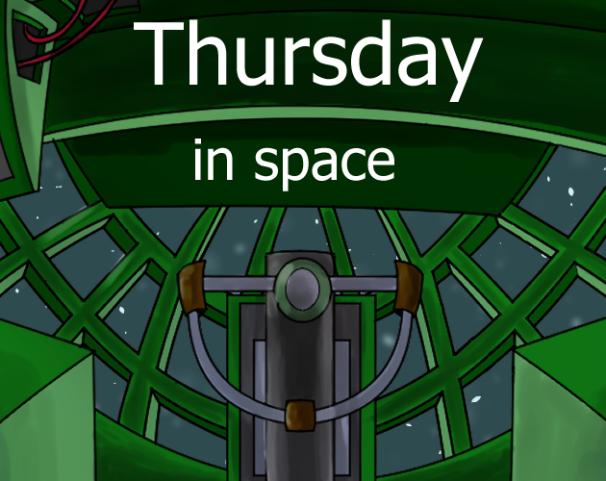
Cover art for the game "Thursday in space"

“Single actions can be moves in many games at once.”

That’s John Padgett and Christopher Ansell describing robust action, the mechanism that the Medici family used to retain power in 15th century Venice. (Xavier Marquez also writes that robust action was how Francisco Franco managed adversarial factions in the 20th century.) 

TL,DR: When there’s more than one reason to do something, it’s more likely to get done. That’s true whether you’re manipulating political rivals or giving time and attention to the ideas in your own unruly brain. 

It’s why Donald and I participated in the 2023 Neo-Twiny Jam.

Why we did it

Our goals were: 

  • Publish a game in 2023
  • Develop mechanics that could be implemented elsewhere
  • Apply novel constraints to inspire creativity
  • Reach a larger audience through the game jam community

Making a public commitment to the game jam held us accountable. Participation was also linked with donations to an anti-hate group, which was a nice bonus.

How we did it

The jam’s 500-word limit was around the length of an in-depth blog post. That gave us room for an introduction, a conclusion, and 3 to 5 decision points that could be 70 to 100 words each, depending on how many choices we provided. 

We wanted the experience to feel like being an Amazon driver in space, and Donald’s artwork did a lot of the heavy lifting to reduce wordcount. He spent time googling images of tug boat galleys for reference, working to establish the cramped environment of the ship along with its worn and threadbare equipment

This was the first time our projects used Clip Studio Paint, and the short time frame forced Donald to learn the program quickly. The claustrophobic reference images started getting to him, but the end result constrains the player within a cramped world. 

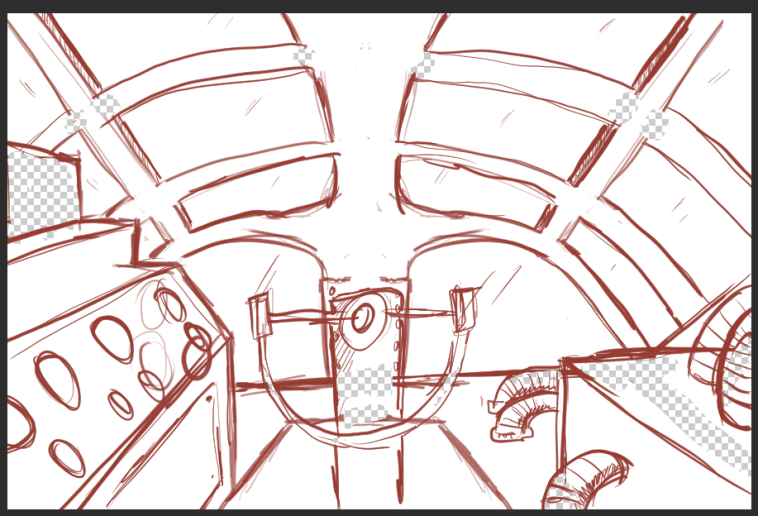
Initial sketch of a ship interior from the game "Thursday in space"

Following Emily Short’s recommendation for writing the through line first, we put together a linear story that had 5 choices. Then we broke up the story to present the first 4 choices in any order — the Good Place approach of “taking something great and ruining it a little so you can have more of it” — which made each playthrough a bit different. 

We used one MS Word document to track the wordcount in our display text, and a separate Word document held design notes and lists of things to do. As we got closer to the game’s release date, we did more coordinating via Discord messages. Not very sophisticated, but everyone has their own approach.

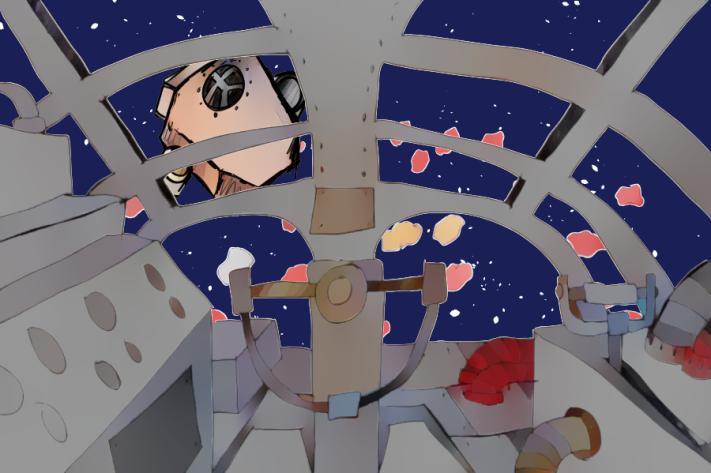
More detailed, colored imagery from "Thursday in space"

Thursday in Space involved more CSS work than our previous games. The sidebar uses Terminal with Scan Lines code created by Patrick Himes, and custom work was done for the borders and rounded edges on the buttons at the end of every passage. Code randomly set each button’s destination passage by using pluck to pull from an array of the unread passages. When every passage was removed, the button sent players to the final choice. 

There were 24 different ways to get through the story, which meant that we had to rein in combinatorial explosion by making some choices less meaningful than others. The random order also made it more difficult to test things properly. (Some players have reported that the stowaway doesn’t behave consistently, which is a bug I haven’t been able to fix.)

How it turned out

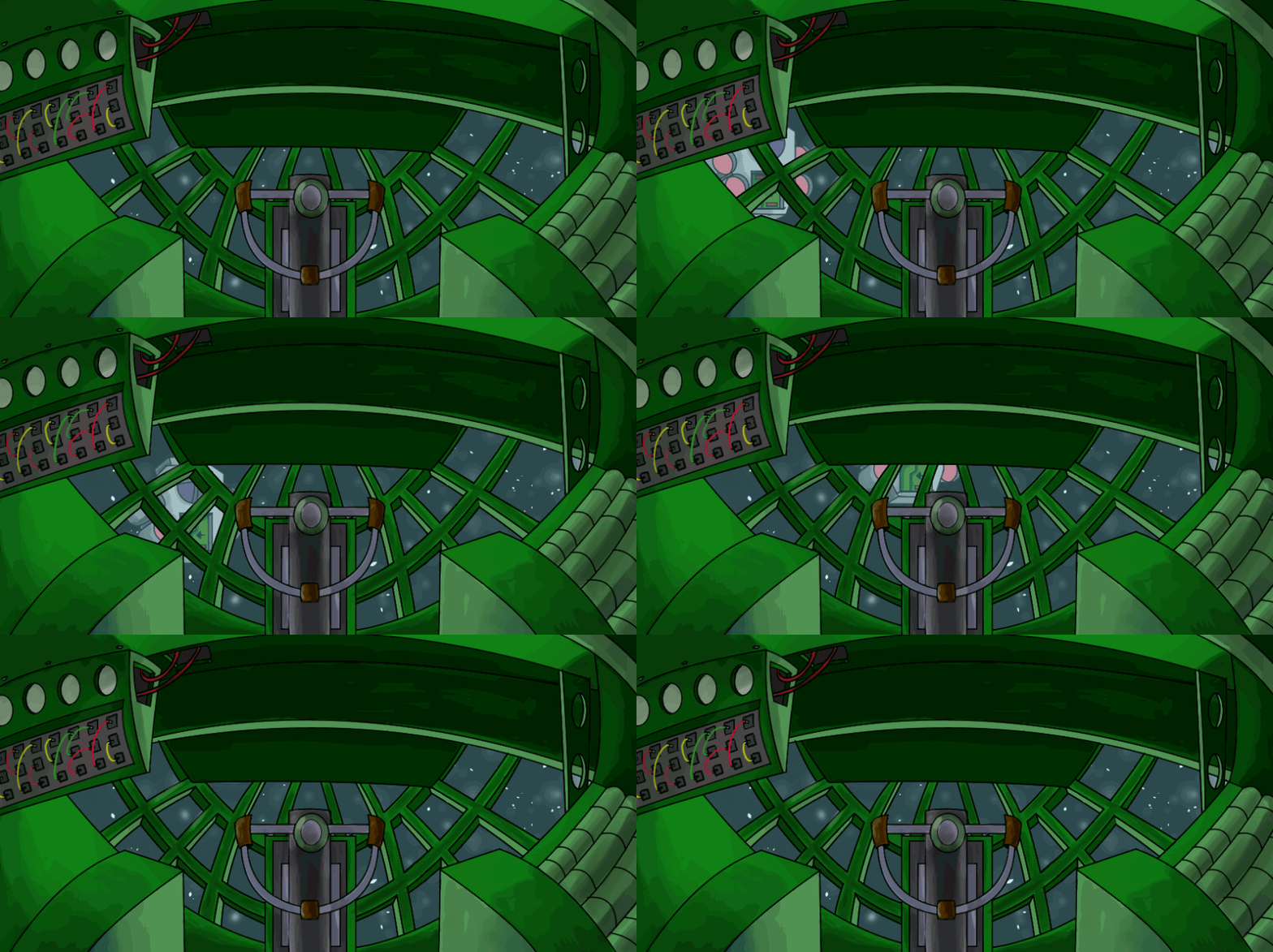
A final animated .GIF from "Thursday in space"

We accomplished a decent number of our goals.

  • Publish a game in 2023

A clear win, in line with the eternally relevant gamedev advice of making and releasing lots of small games to develop your skills. 

  • Develop mechanics that could be implemented elsewhere

Another win, using CodePen and experimenting with new ways for storylets to work together.

  • Apply novel constraints to inspire creativity

On the one hand, the Neo-Twiny jam gave us the focus that we needed to accomplish the first two goals. On the other hand, some of the choices in this story felt less meaningful than others, which the audience noticed. 

  • Reach a larger audience through the game jam community

This didn’t go so well. Sorting the jam entries by popularity puts Thursday in Space in the bottom 20% of entrants. 

Consolation prize: We realized that we could re-use assets from Project Arcmor, our game from 2021, and then we linked to it as an easter egg inside Thursday, in space

Tuesday, February 13, 2024

Game design documents: Plans come in many forms

When I was creating my first games, I didn’t think I needed to bother with design documents. 

Eventually, I realized that I was creating them anyway. I left notes for myself in various formats:
  • Comments in the code itself. It’s right there, which makes it easier to reference, but it gets distracting. The other problem is that it gets tricky to clean up comments later (unless you’re okay with distributing exasperated rants about your buggy, poorly implemented code).
  • Plans written on paper. Working in a space outside the game’s systems — especially outside of the computer — helps for visualizing problems in new ways. The tough part is maintaining the discipline necessary to convert those solutions back into digital formats.
  • Digital files. Donald and I have been doing more with Google Drive documents, and digital records are useful for copying and pasting ideas between plans and projects. The risk is that “the map is not the terrain”: It’s easy to waste time perfecting the design document instead of developing the game. 
Each format has its own strengths, which is why the broader concept of “what a Game Design Document should look like” ends up being such an amorphous glob. I have found many perspectives online:

  • What should a Game Design Document consist of and why should I write one? Thomas Steffen asks and answers this question, asserting that “Builders don’t just build, they make blueprints and follow measurements.” He also notes that the document will need to be flexible enough to accommodate changes and iterations during production. 

  • How To: Write a Game Design Document is the full Game Developer treatment from Danielle Riendeau, discussing common elements and providing examples (design documents from Grim Fandango and Deus Ex).

  • Creating a Game Design Document is Brenda Romero sharing her thinking. She writes, “There are sometimes multiple ways to do something right in the game industry.”

  • Common game design documents is a collection of archetypes put together by Max Nichols. He dismisses the idea of a monolithic, contains-every-detail-you-need design document as “a tidy fantasy.” Instead, he lists different ways that teams can communicate necessary information.

  • Game Design Document template for independent developers was created by Jason Bakker. I liked his advice to “Be thorough, but don't be absolute. Remember that everything must be allowed to change and evolve over the course of the project, and the design document is a general description more than a blueprint.” 

There are also documents online for Grand Theft Auto, Diablo, Doom, and Monaco

Ultimately, the game design document ends up taking on whatever form is most useful for the team that needs to use it. (Game design is all about testing and experimentation, which includes experimenting with the tools you use to make it easier.)

Saturday, December 9, 2023

Applying and Improving 3 Types of Narrative Choices

Picture of a hand placing papers labeled "bad" and "good."

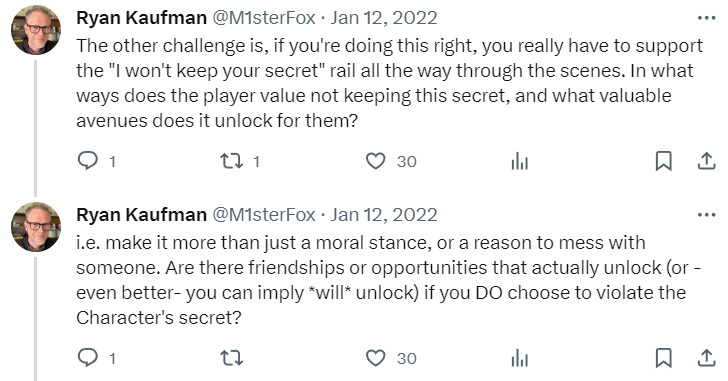
I'd like to preserve some information that’s at risk of being destroyed by capricious billionaires: Ryan Kaufman's brief list of narrative choices.

Choices to access content 

Extreme versions are just “choose ‘yes’ to continue.” (See also: Dragon Warrior’s infamous “But thou must!”) 

Less extreme versions gate off side content — something like asking the player if they would enjoy a game of chess. Kaufman noted that most players don’t get much value from choosing NOT to do something. 

Instead, these choices can become opportunities to provide an "active no" that reveals additional details about a story and its characters: 

Tweet from Ryan Kaufman that reads "Consider changing this to an active No (if you must) by reframing the choice as a role-playing moment? Choice 1: Sure, I'd love to help! Choice 2: Card tricks are demeaning to magic! This allows you to follow up on both choices with a personal or emotional reaction from NPC X."

Choices to express an opinion

I’m ambivalent about reflective choices — asking players how they feel about things — because I can’t think of any times when they improved my enjoyment of a game. Cat Manning has explained that it takes an awful lot of work to do them well

On Twitter, Kaufman also pointed out that there are risks involved:

Tweet from Ryan Kaufman that reads "The What Do You Think Question Nothing breaks immersion like the game stopping and asking the player "what do you think?" It can feel like we're breaking the 4th wall. When we want to ask the player's opinion, we have to camouflage it a bit more."

The worst abuses are authors using “how do you feel about this?” in place of “choose ‘yes’ to continue.” The story moves forward on rails regardless of how the player feels about it.

Kaufman’s recommendation was to link these choices with actual changes in the narrative, possibly adjusting the character’s inventory or abilities to reflect their answer.

Choices for a secret, third thing

My favorite segment was the choice to keep another character’s secret. This happens in Outer Worlds, where the main character has several opportunities to turn Phineas Welles over to the authorities. (That game had some problems, but choosing to reveal the location of Welles’ base had significant implications for the story and the main character’s role in it.)

Kaufman pointed out that these choices should be introduced early, because the decision to reveal a secret has more emotional weight if the player has been keeping it for a while. 

A sequence of tweets from Ryan Kaufman that read "The other challenge is, if you're doing this right, you really have to support the "I won't keep your secret" rail all the way through the scenes. In what ways does the player value not keeping this secret, and what valuable avenues does it unlock for them?" and " i.e. make it more than just a moral stance, or a reason to mess with someone. Are there friendships or opportunities that actually unlock (or -even better- you can imply *will* unlock) if you DO choose to violate the Character's secret?"

Building on these choices can add new dimensions to a narrative, especially when the different types of choices are connected. Choosing to keep a secret can lead to follow-up choices that ask how a player feels about their actions. 

Are they the type of character who will go to extreme lengths to help a friend, or will they abandon a friendship to adhere to a strict moral code? 


Saturday, November 18, 2023

Learn to Test


I used to think it was silly when shows had futuristic computers narrate what they were doing. 

You know, those little stream-of-consciousness declarations, like “scanning the area for life forms” or “initiating self-destruct sequence”? They seemed like cheap writing trying show the audience that things were happening.

Now that I have more programming experience, it makes more sense.


My early coding efforts — in Twine, so we aren’t even talking about something complicated — were nightmares of frustration filled with obscure error messages and opaque syntax warnings. Early versions of the SugarCube documentation didn’t make a lot of sense to me, and it was slow going trying to sift through Q&A pages for answers.1

It was easier to loiter in the Interactive Fiction Community Forum, where I found Linus Ã…kesson2 sharing a useful metaphor about building bridges. It's okay to start with something feeble, because you can build on it through a gradual process of refinement and evolution. 

As I beat various projects into shape — leaning on the bridge metaphor and applying McDonald’s Theory — I learned the four possible states in which code exists:


My coding efforts are still full of errors and janky syntax, but now it’s easier to find and fix the problems. If my projects need less development time, it’s not because I’m faster at coding. It’s because I’m faster at identifying where things failed. I have become better at testing. 

These improvements came from using more comments in the code and indicators that explain what's going on. When it's easier to see where things are failing, it's easier to identify where you should fix them. 

In that context, it makes more sense to have the computer announce that it’s scanning for lifeforms or initiating a self-destruct sequence.

1. I should note that Twinery.org is much more user friendly in the present day.
2. You may recognize his name from the “8-bit Baroque Metal” performance that recently took certain corners of the internet by storm.3
3. That wasn’t an intentional pun, but it works. SORRY I’M NOT SORRY.


Sunday, May 28, 2023

Game Exploration Done Well

(Image credit: Pixabay PIX 1861)

A while back, Overthinking It discussed how players enjoy exploration and discovery in video games. The argument was that a discovery is something players learn or find. A good discovery provides a thrilling sense of accomplishment, but these discoveries are only made through the process of exploration.

From a design perspective, it’s not enough for your games to have discoveries that entertain players; the players need to enjoy — or at least tolerate — the exploration that leads to those discoveries.

Forgotten Tavern tried to apply this concept with discoverable equipment upgrades. As the story progressed, scene descriptions changed over time to encourage exploration and lead players to better equipment. (Feedback suggested that the discoveries were appreciated, but the exploration mechanics could have been improved.)

The Ultima series gives better examples of a well-executed exploration/discovery process. Jimmy Maher at The Digital Antiquarian explains

“The gratification that comes when another piece of the puzzle falls into place is considerable. Ultima has always been better at delivering that thrill of exploration than just about any other CRPG. [….]Ferreting out these secrets and hidden mechanics contributes to another thing Ultima always does well: making you feel smart.”

Maher calls it “exploration,” but finding secrets and hidden mechanics sounds more like “discovery.” This difference is noted in Andrew Plotkin’s comment on a post about Ultima IV:

“It was an exercise in detail-oriented patience. You *can* see that extra pixel if you look for it *every time*, and if you don’t — well, you’re playing the wrong game. Similarly, every NPC has something to tell you, and you plumb their stupid conversation keywords until you find it. If you haven’t seen the other side of a lake or mountain range, you’re not done with it.”

The Ultima games were designed to support exploration that led to interesting discoveries. These dynamics are also seen in a more recent game, Fit for a King. It has graphics that are clearly influenced by earlier entries in the Ultima series:

Fit for a King screenshot via Kitfox Games
(Image via Kitfox Games)

But I was delighted to learn that the similarities are more than visual. Fit for a King has 26 royal commands that are used to unearth buried treasure, yell secret phrases, and discover hidden details throughout your kingdom.

The game is described a non-linear sandbox, but Fit for a King has more structure than its description suggests: you are trying to find new ways to impress your rival before the big summit at the Field of the Cloth of Gold. It’s fun to explore the world, but it’s also rewarding to discover new and extravagant treasures that accomplish your goal.

The writing easily switches between serious and silly, depending on the circumstances. It's also brief and snarky, providing just enough detail to support the narrative.

After the preparations are ready, the player enjoys a brief exchange with their rival at the summit, and then an epilogue describes how various characters fared. That’s where you learn that the royal commands weren’t just cosmetic affordances  different characters will get married, wage war, and find lasting fame based on the player’s previous actions.

A final message encourages the player to go back and explore some more, which turns out to be a good idea. Fit for a King offers enough discoveries to support multiple playthroughs. 


Friday, January 13, 2023

The Perils of Narrative Dissonance

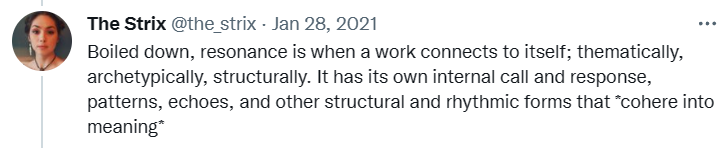
I wrote a public review of Potion Permit — it’s up at Press SPACE to Jump — but the lack of narrative resonance in the game deserves a discussion of its own.

Tweet from @the_strix: "Boiled down, resonance is when a work connects to itself; thematically, archetypically, structurally. It has its own internal call and response, patterns, echoes, and other structural and rhythmic forms that *cohere into meaning*

Stardew Valley, the Rune Factory series, and Story of Seasons games all resonate with the idea of nurturing. They ask you to spend time and attention on short activities for long-term benefit, nurturing crops and relationships that yield rewards.

Potion Permit abandons the ideas of farming and growth. Instead, you run an infirmary to heal sick patients. You brew potions for healing, and your ingredients are gathered outside of town. 

The potions, and their constant demand for ingredients, turn every day into an extractive rampage. The only limits are your own endurance. The exact same objects will appear in the exact same places the following day, so take everything you can find!

Potion Permit screenshot showing tree stumps and crushed rocks.
Success is full of tree stumps, crushed rocks, and cut plants.

You can pretend to be a careful ecologist by taking only what you need, but the game mechanics completely ignore any suggestion of an ecological balance. There’s no penalty for stockpiling absurd amounts of raw materials, and you’ll probably need them later. 

This extractive idea of “harvesting” clashes with the story behind your mission to Moonbury: the player is supposed to heal a long-standing rift between the Medical Association and the local villagers. (The association was exiled after a series of mysterious accidents wiped out native plants that were unique to the area around town.)

Spoiler alert: the conflict turns out to be a big misunderstanding. Chemists didn’t cause these problems, but their knowledge can fix them. The ecological disaster sites end up being excuses to brew Potion X and apply it at Location Y. 

Once the native plants are restored, they're additional resources to extract for your potions. It doesn’t feel like a story about healing environmental damage when the gameplay has you unlocking new areas for exploitation.

All this activity is completely removed from the social dynamics of Moonbury and its inhabitants. In fact, they encourage you to extract additional resources to experience the next installment of their story. Getting to know villagers through daily interactions becomes the thing you do to find out what needs to be extracted next.  

Tweet from @the_strix: "So what are the tools of narrative design resonance? Theme is your strongest ally. Know your themes, know how they translate to mechanics. Thematic patterns echoing in parallel, or like nesting dolls. Characters illustrating themes or challenging them."

Potion Permit ends up feeling like a narrative of colonization and imperial expansion. The capital city, and its bureaucratic medical association, has sent the player to a backwards society that relies on a witch doctor. You are asked to improve that society by looting the surrounding landscape, saving the people from themselves.

I don’t think this colonization theme was intentional! But it’s an interpretation that fits into the spaces left by disjointed narrative design. 


Friday, September 23, 2022

Narrascope 2022: Designing Authentic Choices

Narrascope 2022 was an event organized for people to exchange ideas around narrative games, and it took place on July 30–31. The recordings are available on YouTube

For her Narrascope 2022 presentation, Hélène Sellier discussed how she approached the challenge of creating authentic choices for difficult situations:

 
Sellier and her colleagues at The Seed Crew wanted to design a narrative that provided more nuanced choices than simple options to “accept” or “reject.” This led them to examine the cognitive emotional, behavioral, and somatic reactions to events that are perceived as painful, worrying, or threatening. 

Research by Richard Lazarus and Susan Folkman provided a starting point by identifying two main styles of coping: active and passive. 

“The active coping strategy consists in controlling or modifying the situation by taking action on what causes stress,” Sellier said, and “passive coping strategies consist in denying or avoiding the origin of the problem and diverting our attention somewhere else.” 

These ideas make it easier to keep an audience engaged with a narrative — by shifting the framing from accept/reject to active/passive, people can choose how to respond, but none of their choices provide an opportunity to completely reject the situation. 

Within this new frame, Sellier and her colleagues also wanted to provide a wider range of choices. Ideally, their narrative would offer three to five options, but they also wanted to avoid implying that some choices were morally better or worse than the others. 

Sellier explained that Jakobson’s functions of language ultimately provided a way to create a larger range of dialogue options that still felt authentic. Sorting Jakobson’s six functions into active and passive responses created four final options: passionate, rational, conciliatory, and flippant. 

The result is a set of categories that apply to a broader range of narrative situations. “We wanted the model to become compatible with neutral events,” Sellier said. “We do not want to single out discriminatory situations from other moments of the story.” 

Seed Crew applied this framework to RecovR, an episodic narrative game that addresses diversity and inclusion issues like sexism, ableism, and racism. They have chosen a difficult task in trying ot create choices that feel authentic for these situations, but their work is grounded in published research and thoughtful approaches to game design. 

Wednesday, August 31, 2022

Narrascope: Chess and Narrative Depth

Narrascope 2022 was an event organized for people to exchange ideas around narrative games, and it took place on July 30–31. The recordings are viewable on YouTube.

I watched Nessa Cannon’s Narrascope presentation, “Using chess as a metaphor in game narrative.” The title accurately summarizes its contents:


Cannon drew on her background — someone who started playing chess at the age of 3, and who later worked as a chess coach — to discuss how the game and its pieces have been accumulating symbolic meaning for centuries. This means that the symbolism of chess can easily be integrated with other thematic elements, and Cannon identified three ways of involving chess in storytelling:

  • Overt chess inconography. The example that Cannon gave was the character from Phoenix Wright: Ace Attorney whose office includes a chessboard. It’s a prop to make them look smart.

  • Characters representing specific chess pieces, which is something I have seen in The Avengers: it’s a pair of characters named “Knight” and “Steed” who work for a higher authority and foil the plots of diabolical villains.

  • “Chessboard subtext,” where story elements reflect the interactions of chess pieces on a board. This rarely happens on its own; authors often include one of the other approaches to call attention to the subtext.

It turns out that there are more possible variations of chess games than there are atoms in the observable universe, which means that dedicated enthusiasts will find historical matches or sequences of moves that fit almost any story. 

This symbolism moves in either direction: writers can start with a chess game and develop it into a story, or enrich an existing story by drawing parallels with chess strategies. Weak stories can also benefit from chess allusions to appear more fully developed. And when I say “weak stories,” I specifically mean Kingdom Hearts III. 


Cannon brought up Kingdom Hearts III during her talk to note that it opens with two characters playing chess. “Seeing this, like, in the very beginning of the game, shows a lot of how methodical these characters’ plans are.” She pointed out that it suggests “there’s a long game going on, and the people have been planning this for a really long time.” 

I support that interpretation, but I’m reluctant to say that the subtext is applied consistently throughout Kingdom Hearts III. The overall plot is a barely functional pile of excuses — the entire franchise exists solely to escort players through experiences with various Disney properties. 

(And that’s fine! I had a lot of fun re-enacting Disney moments while smacking monsters with a giant key. It’s entertaining, but I would not hold this series aloft as a triumph of narrative elegance.) 

The good guys in Kingdom Hearts III win every time, and there are only so many ways to maintain dramatic tension in that situation. The idea of a grand strategy is invoked to claim that you were supposed to foil evil plans at Location A, that it was a ruse to draw you away from something sneaky happening in Location B.  

But this ultimately proves Cannon’s point about chess being a way to enrich narrative experiences. "It's really powerful," she said. "I think that it's really under-utilized." 

For intricate stories, the inclusion of chess metaphors can add extra depth. For shallow stories, chess imagery can disguise the lack of a coherent narrative. 

In Cannon's words, "It'll add a layer to your game that might not have been there before."


Tuesday, May 18, 2021

Getting Started with McDonalds Theory

None of my projects could have been completed without the McDonald’s Theory. It’s one of the most useful pieces of advice I’ve encountered. As Jon Bell puts it: 
“There’s no defined process for all creative work, but I’ve come to believe that all creative endeavors share one thing: the second step is easier than the first. Always.” 
Bell’s theory makes that first step less difficult — when you start with the worst possible option, it’s easy to improve from there.
 
Good creative work involves making gradual improvements to an initial idea. That’s tricky when your inner critic won’t let you commit to something, but it’s simpler when you commit to making that idea terrible. 

Once you’ve declared that the plan is to eat at McDonald’s, it becomes much easier to make better plans. 

Jon Ingold made a similar observation when he discussed his approach to writing games with meaningful choices. “No one has the time to be brilliant all the time,” he said. “You need to just get it down, and get it better.” 

After you’ve gotten it down, the terrible idea might look too terrible. Things can seem so dismal that there’s no hope for improvement. That’s when it’s important to remember that everyone has difficulty judging the value of their own work. 

Authors never know how their writing will be received. Editors always overlook typos in their own material. Charles Darwin thought he was “the most miserable, bemuddled, stupid Dog in all England,” although other scientists disagree. 

It’s impossible to tell whether you’re working on something amazing or something awful — Kara Cutruzzula spent a year setting herself up for failure and described it as a process where you “vacillate between extreme narcissism and extreme self-loathing.” 

The narcissism helps you create things, and the loathing helps you improve them, but the risk of public failure is the only way to learn what other people think. 

The good thing about failure is that it presents opportunities to learn and improve. Cutruzzula ultimately viewed every failure as a brick. “As long as you keep laying bricks,” she wrote, “you will build something.” 

The key is to learn from each failure and move on to the next project. To start that project, you need to come up with an idea. That’s when it’s useful to return to the McDonald’s Theory.


Saturday, April 10, 2021

The Carnegie Rule of Game Design: How to Make Things Interesting

Dale Carnegie wrote How to Win Friends and Influence People back in 1936, and I've heard jokes about it for my entire life. The book gets thrown around as a cliché because it serves as a useful way to communicate. (If it wasn’t useful, people wouldn’t be citing it almost a century later.)

One of Carnegie’s rules says that if you want to be interesting, you should be interested in others. That’s helpful advice for game design.

Being interested in your audience can help you find ideas that resonate with them. An interest in psychology can find better ways to keep that audience engaged. Being interested in topics, methods, and concepts from other disciplines will improve your final product.

Here are 6 ways that being interested has led to more interesting games:

  • Be interested in travel. Xalavier Nelson Jr., an award-winning narrative director, created An Airport for Aliens Currently Run by Dogs after spending a lot of time in airports. In an interview, he explained that “when you spend that much time in airports, they break your brain.” (He also worked on Hypnospace Outlaw, which has been described as a flawless piece of historical fiction — much of its impact comes from an interest in 1990’s internet culture.)
     
  • Be interested in medicine. Jane McGonigal has designed alternate reality games and written two New York Times bestsellers. After she suffered a serious concussion in 2009, she faced lasting complications that meant a long and difficult road to recovery. McGonigal saw it as an opportunity to apply design theories in a new context, and the result was SuperBetter. It's a healthcare game that has been used by more than a million people fighting depression, anxiety, chronic pain, and traumatic brain injury.

  • Be interested in mythology. Emily Short created Counterfeit Monkey and Galatea, and she also helped build interactive fiction tools and procedural storytelling projects. Short used her knowledge of ancient Greek and Roman mythology to discuss how an in-game pantheon can create more interesting mechanics and enrich stories. More game design topics and techniques are discussed on Short’s blog.

  • Be interested in pioneers. Aaron Reed has received recognition for innovative narrative and story design, and he created Blue Lacuna, which is considered to be one of the top 10 interactive fiction titles of all time. In his 50 years of Text Games project, Reed has tracked the evolution of a genre and discussed how dynamic stories have connected with audiences across generations.

  • Be interested in dinosaurs. At a young age, Kim Belair’s interest in dinosaurs led her to Castle Infinity and formative experiences with one of the internet’s earliest multiplayer communities. She went on to write for Assassin’s Creed Valhalla and contributed to Goodbye Volcano High, founding her own narrative development company. Belair’s limited history of Castle Infinity explains how her early online adventures have stuck with her.

  • Be interested in communities. You might have seen Victoria Tran playing Among Us on Jimmy Fallon’s Twitch stream. Tran is community director at Innersloth, and she has built healthy, engaged communities around video games by being interested in the players. Her work focuses on nurturing practical, more sustainable, and kinder online communities. 
Ultimately, your own work can be improved by studying the work of other designers. Game jams, competitions, and online events are a good way to see how people have solved common problems and taken new perspectives on familiar issues. One example is the Spring Thing Festival of Interactive Fiction, which happens every April. 

The 2021 Spring Thing event has thirty-eight entries made by designers who are interested in 1970’s sci-fi shows, arcane mysteries, and other surprises. One entry even mentions Dale Carnegie’s book.