Saturday, October 8, 2022
Blood Island: IFcomp 2022
Friday, October 7, 2022
Headights: IFcomp 2022
Headlights is a parser-based work by Jordan White entered into IFcomp 2022. It was created with Perplexity.
The action in Headlights consists of looking at everything to find items that can open new locations. It relies on an artificial sense of urgency, continually telling players to hurry, that is not supported by any gameplay mechanics. Mostly, these reminders drew my attention to the lag between typing a command and receiving a response.
There’s no real “search” command with Perplexity — an object’s notable features are revealed when you look at it. The default state of objects involves less description, which led to an infuriating encounter with “a bush, a bush, and a tree.” (You couldn’t look directly at either bush, because the parser didn’t understand which bush you wanted to check, but “look at bushes” eventually revealed that each bush had its own identifying adjective.)
Overall, Headlights felt more focused than Kidney Kwest, the last Perplexity game I encountered. Most of the experience involved looking at objects and applying them logically to move to the next location. I particularly enjoyed the puzzle that involved a surge of adrenaline, because it did an unusually good job of using a narrative to justify the following sequence of events.
Headlights worked smoothly when the parser and I stuck to clear language and simple concepts, which raises interesting questions about the future of Perplexity as a game design tool. Creations like Lost Pig, Vain Empires, and Zozzled are entertaining because they play with unconventional language and abstract concepts, and it may be difficult for Perplexity to enjoy similar success.
Thursday, October 6, 2022
To Persist/Exist/Endure, Press 1: IFcomp 2022
To Persist/Exist/Endure, Press 1 is a choice-based work of fiction created for IFcomp 2022 by Anthony O.
This entry was small and polished. It was created with Texture, and it involves moving verbs from the bottom of passages onto highlighted words above. Most of the action involves selecting options from phone menus, but a few choices offer glimpses into an existence outside of the automated call center script.
This work was entertaining and responsive, and I particularly appreciated how hovertext confirmed my intended choices before I executed them. (When I tried playing it on a phone, it was very helpful to see whether I had moved to the right spot in the itemized lists.)
I also liked the options that were available, including the choice to continue in Polish. The main menu suggested some interesting possibilities, and it found creative ways to redirect players back to the central set of choices. I kept hoping to find out more about monsters under the bed, but I might not have been clever enough to make the right selections.
To Persist/Exist/Endure, Press 1 could be an interesting component in a larger work of interactive fiction. I enjoyed exploring it, but I was ultimately frustrated by my inability to make any material changes in the main character’s circumstances.
Wednesday, October 5, 2022
The Hidden King's Tomb: IFcomp 2022
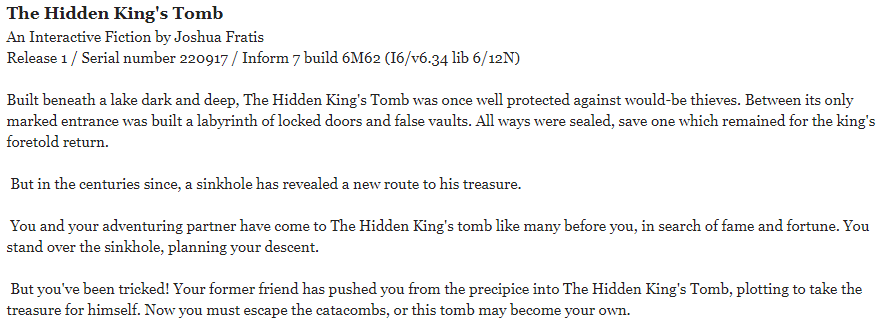
The Hidden King’s Tomb is a parser-based entry submitted to IFcomp 2022 by Joshua Fratis.
As a text adventure, this entry covers all the bases. The Hidden King’s Tomb has treasures to collect, puzzles to unlock, and secret rooms to reveal. It’s a functional scavenger hunt — game historians have already chronicled how the earliest text adventures were scavenger hunts, so this entry continues a fine tradition.
However, many of the early text adventures had extrinsic motivation that broke the fourth wall to let audiences know when they were making progress. The Hidden King’s Tomb downplays these game-like aspects to leave players alone with their intrinsic motivations. If you don’t want to find out more about the Hidden King and the events that led him to bury his secrets beneath “a lake dark and deep,” then there’s little reason to enjoy your exploration.
The classic phrase describes interactive fiction as a narrative at war with a crossword, and I would have enjoyed seeing more of the narrative that created these puzzles. I found very little backstory about the king, his queen, or other figures within the tomb. Many of the locations were richly described, but their descriptions fell flat when I tried to examine objects and features that weren’t implemented.
The introduction mentions “a labyrinth of locked doors and false vaults,” but I only found one locked door. The gameplay might have involved a labyrinth, but that might have been an issue with my own reading comprehension; I found it difficult to identify how different locations related to each other.
Despite my complaints about The Hidden King’s Tomb, I still managed to blunder my way to freedom. It was smoothly implemented, and I would have appreciated a chance to explore further.
Sunday, October 2, 2022
Use Your Psychic Powers at Applebee's: IFcomp 2022
Use Your Psychic Powers at Applebee's is a choice-based comedy by Geoffrey Golden that was entered into IFcomp 2022.
This entry quickly establishes the stakes involved: the success of your next Zoom meeting with corporate depends on your ability to push Schtupmeister beer on a restaurant full of unsuspecting marks. It delivers an entertainingly goofy night on the job.
There are five different narrative threads that you can focus on, using either your psychic powers or more mundane observational skills. The key is to intervene at precisely the right moment, and spending too long with any one story risks missing a key moment elsewhere.
I really enjoyed the tone of this entry, which fully embraced the absurdist corporate marketing deployed by retail food and beverage companies, describing edible horrors like Sriracha whipped cream that sounded just plausible enough to exist.
It’s all delivered with a cheerfully sociopathic indifference:
But it’s also worth noting that this entry, which asks you to engage in guerilla marketing to promote Schtupmeister beer, feels like its own work of guerilla marketing to promote the Adventure Snack Newsletter.
And that’s fine! I honestly enjoyed reading through this story several times to explore each narrative thread and the ways that they could be pushed to interact with each other.
Lord knows that there have been stunt entries in previous years that weren’t nearly as entertaining.
No One Else Is Doing This: IFcomp 2022
No One Else Is Doing This is a choice-based community organizing simulator by Lauren O'Donoghue that was submitted to IFcomp 2022. It uses a second-person perspective to burden you with the task of going out on a Friday night and collecting £5 in dues for a community union.
This entry is well written and smoothly implemented, combining large themes and small details to wrap the entire story in an overwhelming sense of futility. You are clearly not part of the community that you visit, located “in a ward the other side of the city from your own home,” and the union keeps itself at a distance, working through an authority figure that keeps encouraging you to collect money.
There are 32 houses that you can visit, and each one is experiencing its own problems. Even if you take notes and focus on the houses that are most likely to pay dues, the text continually questions your choices and doubts your impact. (Are you willing to encourage a bigot's prejudiced rant if it helps you meet your quota?)
You also have to manage your own needs, because the shift ends early if you get too cold or ignore the fact that you need a bathroom break. You can goof off by reading news headlines and texting your colleagues, but their lack of commitment makes your own dedication seem even more pointless.
I particularly appreciated the “glossary” in No One Else Is Doing This. It felt like the basic information that this faceless organization would provide to new volunteers, telling them just enough to get them started.
This entry ended so abruptly that I restarted it without noticing, and that appears to be an intentional design choice that drives home the futility of your efforts.
If you aren’t going to do the work, somebody else might. And if nobody does it, will anyone notice?
Chase the Sun: IFcomp 2022
Chase the Sun is a choice-based entry for IFcomp 2022 created by Frankie Kavakich.
This entry might be the depressing story of a person who gives up in the face of an unstoppable disaster. It could also be an encouraging connection between two people at the end of the world. (And it might have been an attempt to create a meta-narrative about persistence in the face of adversity? I thought that there was no way to avoid bleak destruction, but I kept trying options until I found something positive.)
Chase the Sun puts a lot of effort into establishing a specific atmosphere with its early passages:
“Pennsylvania is known for its winding, aimless back roads like it was known for its abandoned coal mines and its flirtatious relationship with religion. That is to say, only the locals know the grimy, dirty truths.”
It says exactly where you are and how the protagonist feels about it, presenting a consistent, richly described world that holds up across several readings. I appreciated how statements that seemed odd or out of place in the early passages were explained elsewhere in the story.
On the other hand, it would have been helpful if the story mechanics had received a similar level of attention. This work was created in Texture, and it asks readers to drag words from the bottom of a passage to connect them with highlighted points in the text above. In theory, Texture enables new types of interactivity. In practice, a lot of that potential went unused in Chase the Sun.
From a game design standpoint, there’s almost no difference between passages that end with “click to continue” and passages that end with a single verb to be moved onto a single highlighted noun.* Chase the Sun had both types of passages and some other design compromises that felt more like awkward attempts to deliver additional backstory and less like a valid method of reader participation.
My overall impression was that stronger editorial choices or conscious design changes could have improved this story’s focus — there were a few satisfying combinations of words that moved the story forward, but it made the other sections feel under-developed.
It’s a solid work of fiction that would benefit from some improvements to the user experience.
*You could argue that dragging words around makes the reader actively participate in the suffering of this protagonist, but the 2018 IFcomp entry Bogeyman did a fine job of exploring complicity and torment without an interface like Texture.
Saturday, October 16, 2021
Grandma Bethlinda's Remarkable Egg: IFcomp 2021
Grandma
Bethlinda's Remarkable Egg is a parser-based marvel created by Arthur
DiBianca. The egg is a marvelous toy, both as an in-game object and as an entry
in IFcomp 2021.
I really enjoyed the way that this work combined strong
writing with strong coding. You might think
that you want to pick things up, move to different locations, or interact with
a bigger world through the parser, but the story provides elegant distractions to
explain why you won’t be doing any of those things.
Grandma Bethlinda's Remarkable Egg has discarded a lot of
familiar parser actions in favor of custom commands. There’s supposed to be a
manual that explains how everything works, but… you’ll find out for yourself in
short order. Meanwhile, the new commands introduce persistent changes into the environment
that interact with each other in unexpected ways.
I thought this entry hit the sweet spot between creating
challenges for the programmer and delivering enjoyable experiences for the
player. Other entries have fallen flat when authors
experimented with technical challenges instead of making design choices that
support the story, but Grandma Bethlinda's Remarkable Egg seamlessly
integrates its story and its mechanics with playful explanations.
It was a lot of fun.
Friday, October 15, 2021
RetroCON 2021: IFcomp 2021
RetroCON 2021 is a choice-based work by Sir Slice that was entered into IFcomp 2021.
The blurb for this entry encapsulates its entire story: the player
is at a retro gaming convention in Las Vegas. Although the convention lasts for
2 “days,” you have as much time as you want to explore everything.
This entry has pulled off some feats of programming
that are far beyond my own Twine capabilities. You can play 3 different games
at the convention and gamble on 4 different games in the casino. Each of the 7
options presents a mini-game in its own right, including one that is a functional parser
experience.
RetroCON 2021 was a little disorienting — the
over-arching message of IFcomp is “come and enjoy this group of games,” so it
gets weird and recursive to find the same message inside an IFcomp entry.
It reminds me of Jeff Goldblum’s line from Jurassic Park.
Your scientists were so preoccupied with whether or not they could, they didn’t stop to think if they should. pic.twitter.com/Wo51vZTMgb
— Tom Campbell (@TomCampbell) February 22, 2020
RetroCon 2021 works as a proof of concept, but I would have enjoyed a narrative arc that offered more than arriving at a location and leaving when I got bored.
To be fair, engaging narratives are difficult to implement! Especially when you’re making a game about playing other games. It took a lot of work to build RetroCon2021, and that deserves to be recognized.
Thursday, October 14, 2021
Enveloping Darkness: IFcomp 2021
Enveloping
Darkness is a choice-based story by John Muhlhauser, Helen Pluta, and Othniel
Aryee that was entered into IFcomp 2021.
This cleanly written fantasy adventure is light on details. For example, the protagonist's brother feels like less of a family member and more of a placeholder to provide motivation for the journey.
I did appreciate the number of choices that Enveloping Darkness offers. The passages are short, and the reader is presented with something to do at the end of each one.
However, it would have been helpful if choices hinted at possible outcomes. I got killed early by trying to rescue an innocent victim,
and at one point I spent two inexplicable months in a boat on the lake. It was a complete surprise
when the story ended and I was praised for saving the realm.
Enveloping Darkness also includes several fantasy creatures that don’t feel connected to the narrative. Orcs are used as generic outsiders: some are helpful, some are violent, and some are infested with parasitic brain worms. If they were replaced with Canadians, the overall experience would remain unchanged.
This story could use some developmental edits.
Wednesday, October 13, 2021
Kidney Kwest: IFcomp 2021
Kidney Kwest is an educational, parser-based adventure
designed to reinforce lessons for children with kidney failure. It was created
by Eric Zinda and Luka Marceta, with artwork by Kristina Ness.
I enjoyed the writing in Kidney Kwest. It has the
unavoidable “after-school special” tone that you would expect from the subject
matter involved, but there’s a clear challenge with some basic puzzles and
multiple outcomes. I was also entertained by the Kidney Fairy's sense of humor.
I don’t normally quote the bible, but Kidney
Kwest makes me think of the one about trying to serve two masters.
This entry is trying to do a bit more than that when you consider that it’s:
- reinforcing key messages about taking medications and avoiding specific foods,
- giving people something to do during their weekly dialysis treatments,
- engaging an audience that is 8–18 years old,
- showcasing the “Perplexity” Natural Language Prototype that was designed by Eric Zinda, and
- being judged in the 2021 Interactive Fiction Competition.
Clearly, some tradeoffs have been made.
The overall experience reminded me of AI dungeon —
specifically, the part where I endured a noticeable lag between submitting a
command and receiving a report from that command. This added extra stress to my
Kidney Kwest because a substantial part of the gameplay involves finding food
and taking medication before bad things happen.
(I knew that the delay in sending and receiving responses
wouldn’t really affect my character’s
health, but it was rough having to wait through a sequence of
commands before I could take care of immediate needs. And then it was only a
matter of time before hunger became an issue again.)
I’d call this entry a functional proof of concept, but the
real question is how Kidney Kwest is received by its target audience. If it
encourages people to lead healthier lives, then my opinions (and its final score in IFcomp) are irrelevant.
Tuesday, October 12, 2021
The TURING Test: IFcomp 2021
The TURING Test is a choice-based work by Justin Fanzo that was submitted to IFcomp 2021.
The conflict at the heart of this entry is riveting: You are
the only person on board the International Space Station, and you must
determine which of the two newest arrivals is human. Will you make the correct
decision and save the human race, or will you be tricked by robotic agents of
destruction?
It’s a delightfully tense sequence, but the problem is that
you have to wade through a few thousand words of apocalypse fan fiction — my least favorite
variety of fan fiction — before you get there.
I would have preferred to see fewer passages concluding with a single link. This author is clearly capable of creating meaningful story branches, but most of the time they didn't.
In Twine, the story diagram looks like an enormous vertical
column:

Many of the scenes in The TURING Test should be familiar for people who enjoyed With Folded Hands, Colossus: The Forbin Project, The Terminator franchise, and even The Mitchells vs. The Machines. If there was a larger message about intelligence, morality, or the ethics of interacting with sentient beings, I missed it.
Ultimately, your choice to determine who can access the space station will decide whether the story is disaster fiction or apocalypse fiction. It turns out that they’re separate genres.
Monday, October 11, 2021
Beneath Fenwick: IFcomp 2021
Beneath
Fenwick is the Lovecraft-adjacent story of a remote New England town full
of sinister, malformed humans lurking just out of sight. Pete Gardner created it for IFcomp 2021, and his goal was
to create an experience that is “primarily choice-based but plays like a parser
game.”
On the one hand, I didn’t encounter the branching storylines
that are seen in a choice-based game. There is only one “correct” sequence of
links that brings an audience through to the end of the story. Readers
are free to explore detours on their journey, and they're also encouraged to
save often, because the wrong links will end things early.
On the other hand, I didn’t receive the clues that a parser might provide
when players struggle with specific puzzles. Beneath Fenwick has a “combine” command
that feels a bit vague — sometimes it involves using one object on another, and
at other times it merges objects together, but the error message is always “That
combination does not work!”
I respect the amount of effort that went into implementing and polishing Beneath Fenwick. It’s a smooth experience! I didn’t encounter any broken links or inescapable dead ends, and things functioned consistently.
My main issue
was that the interface overshadowed the story, encouraging me to ignore the
text and hunt for links. This
problem has been discussed in Interactive Fiction communities before.
The writing in Beneath Fenwick is consistent, and fans of this genre might enjoy themselves. I recommend experiencing it for yourself to draw your own conclusions.
Sunday, October 10, 2021
The Corsham Witch Trial: IFcomp 2021
The Corsham Witch Trial is a choice-based story by JC Blair that was entered into IFcomp 2021.
The thing about The Corsham Witch Trial is that it contains
no actual witches — and that’s fine,
there weren’t any at the Salem Witch Trials, either. However, the blurb’s
mention of a “worryingly urgent and irritatingly cryptic” request gets a bit
confusing alongside IFcomp’s other stories of magic and supernatural horror.
The Corsham Witch Trial is a cleverly written courtroom
drama. The author describes it as “a transparent attempt to enliven a
disjointed and gimmick-laden manuscript with a few distracting interactive
elements,” but I really enjoyed how this story was framed. Court transcripts
and other documents are presented as .PDF files, and a workplace colleague asks
questions about the evidence after it has been reviewed.
Every step of the Corsham Witch Trial works very hard to
maintain an atmosphere of uncertainty. When the player analyzes the evidence to
support a specific interpretation, their colleague explains how it can also
support a different outcome.
Unfortunately, after a skillful buildup of tension and ambivalence,
the entire exercise proves to be futile.
It doesn’t really
matter what the player thinks, because the case was closed, the truth was
discovered, and the newspapers reported the results. After such rigorously
enforced neutrality, I was expecting a Broadchurch-style twist that
might suggest alternative sequences of events. Instead, I got moralizing
about doing the right thing even when it’s pointless.
The Corsham Witch Trial is well-executed fiction, but doesn't end up being very interactive. Other reviewers have made some good suggestions for improvements.
Saturday, October 9, 2021
At King Arthur's Christmas Feast: IFcomp 2021
At King Arthur's Christmas Feast is a choice-based adaptation of Sir Gawain and the Green Knight, entered into IFcomp 2021 by Travis Moy.
This is a niche piece — almost a Medieval Boy Scout
Simulator — and I love it. To quote one of the story’s options: “I’m all in on
this. Let’s do it.”
The first thing that an audience should know about the
original story of Sir Gawain is that it
makes no goddamn sense. A movie adaptation, Sword of the Valiant, came out when I was five years old. Scenes
like this did not make it any easier to understand:
At King Arthur's Christmas Feast is written with choicescript, and it offers decisions that put Gawain’s thinking in a more relatable context. The reader is expected to uphold the virtues of a knight, remaining pious, courteous, magnanimous, and chaste throughout the entire journey while also embodying the spirit of fellowship.

The expectations make Gawain’s predicament more understandable: How can good manners keep you safe from an immortal giant?
I appreciated how much extra writing was necessary to humanize Gawain’s adventure. And the story notes many of the reader’s choices, referencing them in future passages.
However, King Arthur's Christmas Feast doesn’t have a lot of branches, which means that people who stray from the correct path might find it less entertaining. I had fun pretending to be a rule-abiding poindexter, but I can see how that might not appeal to everyone.
The House on Highfield Lane: IFcomp 2021
The House on Highfield Lane is a parser-based work by Andy Joel that was submitted into IFcomp 2021.
The player begins by steering Mandy, the protagonist, into a
creepy old house. The rest of the story involves trying to find a way out of
it. I thought that the puzzles were engaging, but the story felt like the triangle of
identities was out of alignment.
The player and the protagonist of The House on Highfield
Lane are kept separate from each other. This happens through narrative details,
like the third-person perspective of the writing, and also through design
choices that isolate the player’s knowledge from the character’s knowledge.
I knew that brevity was the soul of wit, but Mandy didn’t know that, so one of the
puzzles involved guiding her to a place where she could discover the answer. On
the other hand, contraptions in the house were described in ways that made them
seem familiar to Mandy and entirely alien to me.
As she explored the House on Highfield Lane, Mandy might
have been fascinated by the experiments in reversing death and transferring
consciousness. Maybe she was horrified. The narrative distance left me feeling
detached and unmotivated. Escaping from the house became her problem, not mine.
Overall, this was a smoothly implemented parser experience. Many aspects of the house were confusing, but they were intentionally confusing and bound by consistent rules. I didn’t need to spend a lot of time guessing obscure verbs, and the parser generally understood what I was trying to do. The technical craftsmanship was solid, and the narrative choices might appeal to the right audience.
Friday, October 8, 2021
Brave Bear: IFcomp 2021
Brave Bear is a
parser-based adventure by John Evans
that was entered into IFcomp 2021.
Brave Bear is a child’s toy with a solemn duty to keep its
owner safe. I liked the concept, I enjoyed playing with toys, and I liked the
goal of bringing friends together to protect someone that they cared about. I
just wish that some of the clues were easier to understand.
As a toy, the bear has a simple view of the world. As people
who quote Steve Jobs will tell you, “simple” is difficult to implement. Brave Bear’s narrative voice describes an
ordinary family home from a new perspective that felt unnecessarily limiting
and confusing in a few places.
Some of this entry’s other design choices were unexpected —
two toys have abilities that are hinted at but never used in the game, and a
few of the locations have exhaustive lists of exits that are never used. They
might have been red herrings, but that seems out of place in a story where the
puzzles are so simple.
The experience reminded me of Samurai Lapin, which was an
animated flash movie on the internet from (checks
notes) more than 20 years ago.
…now I just feel old.
Thursday, October 7, 2021
The Best Man: IFcomp 2021
The Best Man
is a choice-based story by Stephen Bond that was entered into IFcomp 2021. It’s
phenomenally well-written, which made it a challenge to enjoy.
The Best Man is initially told from the perspective of
Aiden. He has been asked to stand in for the best man at Laura’s wedding, and
that forces him to confront unresolved feelings about their past relationship. Their
story is vivid and uncomfortable.
For the first few chapters, it looked like the author was a “Nice
Guy” who had created an autobiography to process events from his own life. I
was concerned that I’d spend the entire time watching someone wallowing in destructive
behavior.
Then the perspective shifted, and I realized that the author
wasn’t a self-pitying doormat — just unnaturally good at creating narrative
voices. Laura’s wedding is viewed from several perspectives, and each one them feels
distinct and internally consistent.
The Best Man also uses some clever writing and supporting mechanics
to handle its character changes. Colored hyperlinks indicate that the reader
has assumed a new perspective, while Aiden’s eye-catching white suit allows
readers to track him through the scene.
The story is advanced with dialogue choices, and those
decisions are referenced in later passages. I couldn’t tell whether
it meant that I had any control over the narrative, but I managed to get
Aiden to a final state that seemed healthier for him.
It’s possible that Laura’s wedding could have ended quite
differently, but I lack the endurance that would necessary to find out.
Wednesday, October 6, 2021
Unfortunate: IFcomp 2021
Unfortunate
is a parser-based puzzle by Jess
Elizabeth Reed that was entered into IFcomp 2021.
I loved the premise of this game — it puts you in a short,
repeatable scenario as an accretive PC (something similar was used for last year’s The
Copyright of Silence), and you use your knowledge to make predictions as a
fortune teller.
After three runs through Unfortunate, you have enough information
for completely accurate predictions. It poses an interesting question: should you
predict misfortune and then passively watch it unfold? Or do you want to take action
for more positive results?
Unfortunate is an ambitious work, and that ambition may have
created some implementation issues. I found exits that became inaccessible and descriptions
that referenced non-existent objects. And I couldn’t
predict misfortune and passively watch the results, because two characters
completely disappeared from the game.
I would have appreciated it if Unfortunate set out its initial expectations
more clearly; I approach puzzles differently when it’s clear that they’ll be a
repeating sequence. This entry was fun, but more playtesting would have
improved the experience.
Tuesday, October 5, 2021
Smart Theory: IFcomp 2021
Smart Theory
is a short comedy by AKheon that was
entered into IFcomp 2021. It encounters one of game design’s common problems: How
do you simulate an unpleasant experience without driving away your audience?
Last year, Savor described
repeated, excruciating pain. Accelerate expected you to actively
participate in atrocities. And this year, Smart Theory wants you to endure
a training session that blends all the worst aspects of motivational seminars and
religious cults.
The writing is smoothly implemented and effective. It was
fun to see how the “first rule” of Smart Theory was applied in the story. This entry works as a kind of power fantasy — you can mock transparent nonsense
and criticize sloppy thinking.
However, the whole thing felt too plausible. A shamelessly inflated sense of self-importance is part
of every management training course; they all discuss overpriced-but-revolutionary
new paradigms. Attempting to debunk their transparent nonsense is just as
futile inside Smart Theory as it is in the real world.
If you view it without irony, Smart Theory is interchangeable with a lot of the overpriced self-help literature that currently exists. That can be read as a declaration that there are no new ideas in this space, but it feels simultaneously correct and tedious.