Saturday, September 27, 2025

Competitions and Controversies


It’s September, which means it's time for the Interactive Fiction Competition. However, I didn’t expect IFcomp to be another battleground on which the AI conflict is playing out. I thought it was a settled issue ("you'll get AI and like it"), but Bruno Dias wrote a blog post about how “Slop comes for everything you love,” and his sentiments were echoed by Michael Klamerus on his blog.

I'm not happy about AI being welcomed into the Interactive Fiction community, but I also don’t think it’d be productive to advocate for my preferences — as Dias puts it, “the IF community has a certain trauma around gatekeeping of what 'counts as IF'.” I played and reviewed two AI-driven IFcomp entries from previous years, and they were both lacking

(I also remain viscerally offended by "You Will Thank Me as Fast as You Thank a Werewolf," a non-interactive, procedurally generated text that was dumped into IFcomp five years ago and ranked dead last.) 

I've given up on writing reviews for IFcomp. This year I don’t even know whether I’m going to play any entries. I don’t want to deal with the extra work of sifting through titles to find ones that aren’t AI-enabled, and Dias lays out the problem with submitting ratings:

Theoretically, you could rate the AI entries at a 0; whether you bother to 'play' them at first […but] summarily nuking them is a pretty obvious violation of the judge rules. I don't want to participate in a way that will be read by comp organizers as bad faith.

Alternatively, you can play and rate only entries that don't use AI. This would seem to be 'fine' but it creates a dynamic where the only people willing to play and rate the AI entries are people who are not going to object to them on grounds that they are AI, and thus they're getting judged by a different standard than everyone else's work. This means that the final result of the competition is at risk of legitimizing AI use or worse, making someone who put out real work feel bad that they placed behind someone who put out slop.

So that’s what’s up with entertainment. In the news, Ryan Walters has resigned as state superintendent of Oklahoma Schools, which is notable for his impressive track record of generating horrifying news headlines due to terrible judgment.

There was is drive to start teaching the bible in schools. When the state Department of Education revealed its requirements for the bibles it would use, it turned out that, “there are very few Bibles on the market that would meet these criteria, and all of them have been endorsed by former President Donald Trump.”

He announced that out-of-state teachers would need to take an “America First” test before they could teach in Oklahoma. (It turns out that the test wasn’t much more than a way to deliver marketing leads to PragerU.)

And he wanted to set up chapters of Turning Point USA (Charlie Kirk’s conservative organization) at every Oklahoma high school, but it looks like he resigned before that happened.

His biography isn’t complete without discussing that time an image of a naked woman was displayed on a TV in his office during a school board meeting. It could have been a bizarre accident! But we’ll never know, because Walters denied it happened, falsely claimed to have been cleared before an investigation was complete, and insisted that anyone who said it happened was lying.

In gaming, I’m giving myself permission to quit Backpack Hero. It received a lot of enthusiastic praise on social media, but I kind of hate it? I’ve gone into it a few times trying to see if it gets good, but there are better ways to spend my time.
 

Saturday, August 23, 2025

News You Can Lose

Clowns, like sex workers and hack economists from the Heritage Foundation, are paid to entertain people with fantasies.

I still like the idea of blogging regularly about relevant news stories, but you never know what's worth writing about as the start of a bigger, long-term story.

Like that time I got laid off by my (former!) company's Chief Marketing Officer because he outsourced my entire department  layoffs aren't particularly newsworthy, but five years later I'd learn that he (allegedly!) did it as part of a plot to embezzle more than $5 million.

In the present day, there's a lot of talk about people being replaced by generative AI. The adult industry, long recognized as one of tech's early adopters, has two sides of the story about its use managing OnlyFans audiences.  

  • One NSFW creator is very happy with the way generative AI allows her to engage with larger numbers of fans (and how it works to charge those fans the upper limit of what they're willing to pay). She's very thoughtful about the nature of the service she's providing  pointing out that even SFW personalities involve teams of people working to create a fictionalized version of an identity; she sees AI as just another component of that team creating a fantasy for the audience. She also points out that while using AI breaks the rules set by OnlyFans, many of its other rules are broken on a regular basis. ("So as long as they're making money and it's not related to minors, they're probably going to turn a blind eye.")

  • In the Philippines, people at OnlyFans "management companies" experience bleak working conditions that are only getting worse. Sales quotas are increasing and their transcripts are being used to train AI "which would replace the worst performers on the team." They're also aware that their work skirts the OnlyFans' terms and conditions, but they have their own workaround. ("The chatbot generates a message and the creator or a human worker hits send, allowing companies to comply with OnlyFans’ requirement that only humans send messages from a creator’s inbox.")

Elsewhere on the topic of "getting paid to tell lies that people want to believe," I am concerned about the vacancy at the head of the U.S. Bureau of Labor Statistics. 

As a former Fed economist put it, "Large, unpredictable shifts in economic policy are placing unusual strains on our measurement apparatus because they are causing large, unpredictable changes in the behavior of consumers and businesses. These changes are difficult to measure in real time." Measurement difficulties resulted in the previous BLS head losing her job. 

Her suggested replacement, E.J. Antoni:

(Some corners of the internet are also referring to him as "Austrian Screech," and it's hard to disagree.) 

My main concern is that he's going to say whatever it takes to keep his patron happy without understanding the damage he's doing. BLS data has been compared to essential infrastructure  getting it wrong will have ripple affects that cause problems in a variety of systems.   

Image credit: PaintedFeet01 / Pixabay

Saturday, August 9, 2025

Permission to Quit


I’ve been struggling with games that stopped being fun (or never got fun in the first place).

  • Bear and Breakfast: This game progressed smoothly, I enjoyed unlocking different properties, and it was fun designing room layouts that maximized revenue while meeting the minimum requirements for room bonuses. But I’m at the point where upkeep involves too much cognitive load. By the time I’m done crossing the map to keep up with various maintenance tasks, I forgot what goal I was working on — it’s the doorway effect. There are too many moving pieces to track now, and I can’t tell whether I’m moving forward or just running in place.

  • Beholder: This game was dismal. It’s not actually fun to be a low-level cog in an oppressive state apparatus? I’ve heard that Papers, Please does fun things in this vein, but Beholder’s economy is difficult to follow — some of the characters made absolutely impossible demands early on, and I had no idea how to satisfy them. I couldn’t get a handle on how money, information, social status, surveillance equipment, and black market goods can be exchanged for profit. It feels like a game that wants to set up some weighty ethical dilemmas, but they're pretty easy to sidestep if you just stop playing.

  • Kingdom Come: Deliverance. This is one of the most detailed flower-picking simulators I’ve ever seen. I liked that your character can build experience in any one of a million skills, but I didn’t like how experience only comes from successfully using those skills. It took me six hours to find a bow, and I can’t afford enough arrows to practice with it. I can forget about pickpocketing — I keep getting caught and needing to skip town without ever improving. Meanwhile, my gear wears out and I burn through piles of money getting it cleaned and repaired. Gathering herbs is a way to make ends meet, but it has been a tedious, repetitive slog trying to build a character that’s fun to play. I need to stop expecting that that will change.

  • Moonring: It’s a neat idea, but this game will not run smoothly on my computer. It’s incredibly frustrating to struggle with a game recreating Apple IIe graphics that can’t match an Apple IIe’s processing speed. (Look, I’m aware it’s probably doing super complicated stuff under the hood, but my user experience has been laggy and disappointing.) I barely started exploring the first dungeon, but the delay between entering a command and seeing it play out is absolutely killing me. Fiddling with my system settings hasn’t helped.

  • Secret of Darkwoods: This is some AI-generated bullshit. I can’t complain too much, because it was free, but it feels like I’m flipping through somebody else’s completed book of Mad Libs. “Go to [location] and [interact] with [NPC]. Collect [treasure and/or stat bonus].” According to Steam, I’ve already put in more than the average amount of time needed to complete the game. The main quest is supposed to unearth the main character's mysterious backstory, but it hasn't captured my interest and it’s impossible to tell how much more time I'll need because the story progression is so haphazard.

I do try to put some effort into keeping track of which games I have played and completed, so I'm officially noting my intent to put these aside. There are other, more entertaining ways to spend my time. 

I can also spend less time playing games and more time getting creative. On LinkedIn, Small Loan Studio is running a 28-day tiny creativity jam. Each day is a single-word prompt and some encouragement to create a single piece of art every day over 4 weeks. (I think it officially started on August 1, but you can still start it up and follow the 28 prompts on whatever schedule works for you.)  

Elsewhere on the internet, it's Blaugust. It's worth watching, and people are having fun with it this year

Monday, July 28, 2025

We've Been Here Before

(Alternate title: Too Many People are Thinking of the Children)

Closeup image of a sweater with some sheep on it. I dunno. I hate finding images almost as much as I hate formatting them for display.

I’m trying to figure out how to implement a practice of regular updates — something like either the Media Notes or 5 Things format that loudpoet uses. (We'll see whether it's sustainable over the long term.) 

...but I never know where to start with news coverage/commentary. There’s too much to mention and it’s impossible to track it over time. Which stories are going to be ongoing developments and which ones will end up forgotten? 

There was a legitimate political assassination in mid-June, and it got lost in the cracks between the president’s humiliating birthday parade and the armed occupation of Los Angeles. And while those stories were crazy enough to make everyone forget how Social Security data was compromised and the White House served as a car dealership, they were still eclipsed by the uproar that accompanied the public's re-discovery of existing Jeffrey Epstein information. 

(And that recap omits the “Big, Beautiful Bill” travesty.)

It might make more sense to stick with more game-focused news. The story there has been payment processors restricting access to online storefronts. It looks a lot like the 2021 crackdown on adult content, but as Thomas Manuel notes:

This coincides with some weird stuff out of the UK where a law is forcing websites to verify people’s ages before they give them access to information that might not be suitable for children. It’s a weirdly synchronous attack on freedom of expression — an uncoordinated public-private partnership that threatens the few remaining fun/free spaces on the internet.

Payment processors Visa and Mastercard are facing some resistance for this move, and the U.K. age verification scheme has encountered its own issues; people can bypass U.K. protection measures by presenting video game screenshots in lieu of actual age verification. However:


It could affect this year's Interactive Fiction Competition.  

Image credit: Ksenia Chernaya  / Pexels

Saturday, July 13, 2024

Different lessons from Mozart


Geoff Engelstein brought up Amadeus while writing about “the question almost all of us have to wrestle with - what do you do when you realize that you’re very good but not great?”

I… don’t find that question very relatable? (Let’s meet back here later to discuss what it's like to realize that you're very good.)

Amadeus lives in my head for a different reason: it shows that most of us have to make an effort.


In the movie, Salieri is stunned that Mozart’s music needed no editing, revision, or correction. Who actually works like that? A freakishly talented, once-in-a-lifetime genius, that’s who.

The rest of us need to struggle through multiple drafts and revisions while strengthening what works and discarding what doesn’t.

It’s the Ira Glass quote about closing the gap between the works you’d want to create and the works you create when you’re just starting out. You need a lot of practice to develop your skills, and that means being kind to yourself when your early practice falls short. 

Look away from the remarkable brilliance of the person working without rough drafts to recognize that everybody else is experiencing similar struggles to improve. That's why the genius is notable! What made you think you'd be an exception? 

And on the topic of getting a lot of practice, Blaugust is coming up. I wasn’t successful at writing a post every day during the month of August in 2023, but I have published a post every month for the past year, and that’s better than nothing.

Saturday, June 22, 2024

Truck Quest: The cutting edge of 201X

Black and blue strings of ones and zeroes that suggest computer code.

When Donald and I started working on Truck Quest, we needed a design for Samson, the eccentric loner who actively opposed surveillance capitalism. It was 2018, more than 10 years since Anonymous made headlines for opposing the Church of Scientology. “Mr. Robot” had also been around for almost half a decade, which gave us some ideas about what Samson would look like and who he would be connected to.
  
Although the Guy Fawkes mask was an obvious idea, it wasn’t a good fit for our paranoid activist. There’s no way his efforts to undermine exploitative globalization would use a mass produced commodity that generated revenue for a major entertainment conglomerate! Samson might have had some unusual opinions about how society should work, but he wasn’t an idiot.

Instead, we looked at some of 2018’s cutting-edge solutions for remaining unrecognized: 
Samson ended up with several different disguises to remain incognito.


Sunday, May 19, 2024

3 Insights into Procedurally Generated Narrative

As a book, Procedural Storytelling in Game Design has not quite been what I expected. The marketing material declares that “The reader will learn to construct narrative systems, write procedural dialog, and generate compelling characters with unique personalities and backstories,” and that has not exactly been my experience. 

It’s never smart to believe marketing material, but this reads more like a collection of essays?

That’s fine — the essays are written by smart people! — but it’s not a step-by-step instruction manual. Each essay has its own perspective, and they don’t always fit neatly together for a clean set of best practices.

I still copied down some ideas to swipe for later.

I. The Bare Minimum.

In Chapter 3, “Generated Right in the Feels,” Veteran game designer Jill Murray (“best known for her work on Shadow of the Tomb Raider, The Big Con, and a handful of Assassin’s Creed games”) writes about her experiments trying to identify the smallest, sparsest, most sketchy set of details that could make characters seem relatable. “We know that players have a great natural capacity and enthusiasm for attachment and interpretation. Why not provoke them to use it on purpose and shift some of the processing power to the players’ minds, so to speak.”

Murray tested this idea by developing a character generator that created sets of descriptive details. It turned out that providing too many details distracted people from the character by encouraging them to play around with the generator. “A sparse level of detail was more likely to tap into players’ creative minds and provoke them to consider the person behind the list.” 

II. Clever Combinations.

In Chapter 8, “Curated Narrative in Duskers,” Tim Keenan and Benjamin Hill (the creators of Duskers) discuss how identical story components can create different narratives when they’re encountered in different orders. They gave an example with a dead rat and two discussions of how it got there: maintenance technicians explaining that dead rats are found on spaceships all the time, and scientists talking about how it could be a sign that something is seriously wrong.

Test audiences read both perspectives, and “most of those who read the scientist’s email first generally felt the scientist was on to something and the operators were being obtuse, while most of those who read the operator’s conversation first were more likely to think the scientist was overreacting.” Using this insight, they broke their game’s stories into a series of small ship logs from different points of view, allowing players to experience the narrative differently and encouraging them to draw varied conclusions.

III. Planned Absences

In Chapter 18, “Dirty Procedural Narrative in We Happy Few,” Alex Epstein (narrative director for We Happy Few) discusses the challenge of telling stories in a procedural sandbox. He relies on the fact that people will eagerly assemble their own stories from a set of disjointed facts, approaching procedural storytelling with what he calls “dirty narrative.” Epstein says that while good dirty narrative stories have the same elements as every good story, “what distinguishes them is that, instead of trying to make as clear as possible what happened to whom, where, when and how, they intentionally demand interpretation.”

Epstein goes on to explain how dirty narrative can use lies, absences, mysteries, inconsistencies, and tangents to outline negative space around a story that the audience fills in themselves. “All dirty narrative could be boiled down to ‘something should be there but isn’t’ and ‘something’s there that shouldn’t be.’” However, he also warns that dirty narrative is “execution dependent” (i.e., something that will be awful if poorly implemented).

I might have chosen these points selectively to support my own biases (Dear God, these essays make so many points), but it seems like good procedural narrative ends up being willfully incomplete. When a system creates a single, definitive story that has no room for interpretation, it’s tougher to engage with.  

Image credit: wilderjjss / Pixabay

Thursday, April 25, 2024

Avoiding or Adapting Combat Systems for Games


Combat systems are expensive for game designers. Daniel Cook, Chief Creative Officer at Spry Fox, has gone so far as to call them a resource-intensive trap

From an aesthetic perspective, Postgoodism also prefers non-violent game mechanics. When he created Don’t Get Wet, he was concerned about yet another fighting game blending in with all the combat games out there. 

I’ve stumbled through enough game design of my own to implement an RPG-style combat system in Twine, and it wasn’t too difficult. Implementing a system that was interesting and fun ended up being the real challenge. 

RPG combat systems normally rely on a bunch of stats that are engineered to change over time. While I can understand the functions involved in changing those numbers (especially when someone smart explains them), I have difficulty understanding the experiences that they deliver for players. 

Luckily, Daily Adventure Prompts has offered an explanation that uses chess pieces to explain different combat roles: 
  • Infantry (pawn): Low-level threats that take up space on the battlefield and get in the way. 
  • Brute (rook): An outright threat that should not be attacked directly. 
  • Skirmisher (knight): Ranged or highly mobile fighters that target weak spots. 
  • Controller (bishop): Enemies pursuing goals in the background (“the cult priest finishing the disastrous ritual, the master thief making off with the mcguffin”), frequently protected by a hazardous/hard to bypass barrier. 
  • Support (king): Piggybacks on other types of units to make them better at doing their jobs. 
  • Elite (queen): Mixes the strength and abilities of two other types of combatants. “Combine a brute and a support for an unstoppable frontline commander, or infantry and a skirmisher for an elite striketeam that attacks in perfect coordination before fading back into the shadows.” 

These classifications make a bit more sense for me. I still agree with Daniel Cook and Postgoodism: combat systems require big investments that invite comparisons with a massive range of titles, but some of these ideas can make a game's fight sequences more distinctive. 

It turns out that Nessa Cannon was right — more people should be using chess in game design.
 
Image credit: Wadams / Pixabay

Sunday, March 24, 2024

Robust Action: A Thursday in Space Retrospective

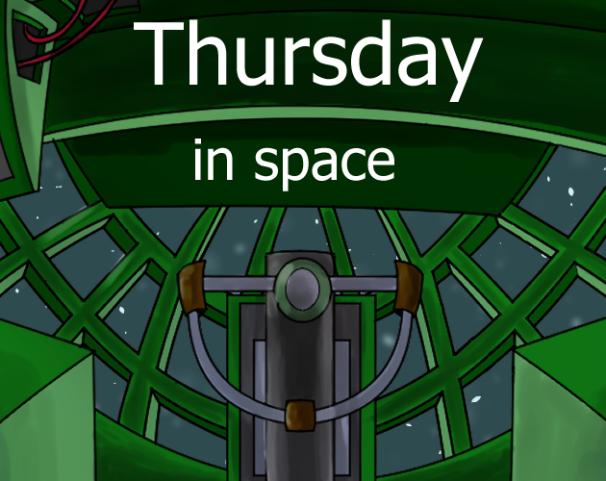
Cover art for the game "Thursday in space"

“Single actions can be moves in many games at once.”

That’s John Padgett and Christopher Ansell describing robust action, the mechanism that the Medici family used to retain power in 15th century Venice. (Xavier Marquez also writes that robust action was how Francisco Franco managed adversarial factions in the 20th century.) 

TL,DR: When there’s more than one reason to do something, it’s more likely to get done. That’s true whether you’re manipulating political rivals or giving time and attention to the ideas in your own unruly brain. 

It’s why Donald and I participated in the 2023 Neo-Twiny Jam.

Why we did it

Our goals were: 

  • Publish a game in 2023
  • Develop mechanics that could be implemented elsewhere
  • Apply novel constraints to inspire creativity
  • Reach a larger audience through the game jam community

Making a public commitment to the game jam held us accountable. Participation was also linked with donations to an anti-hate group, which was a nice bonus.

How we did it

The jam’s 500-word limit was around the length of an in-depth blog post. That gave us room for an introduction, a conclusion, and 3 to 5 decision points that could be 70 to 100 words each, depending on how many choices we provided. 

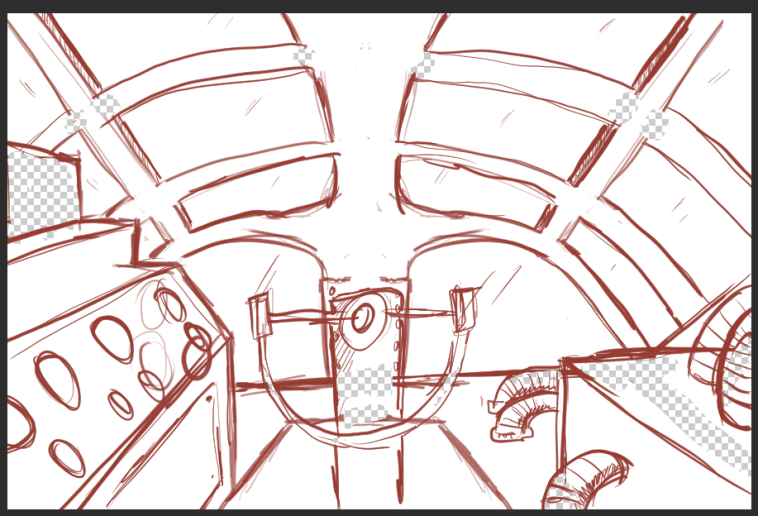
We wanted the experience to feel like being an Amazon driver in space, and Donald’s artwork did a lot of the heavy lifting to reduce wordcount. He spent time googling images of tug boat galleys for reference, working to establish the cramped environment of the ship along with its worn and threadbare equipment

This was the first time our projects used Clip Studio Paint, and the short time frame forced Donald to learn the program quickly. The claustrophobic reference images started getting to him, but the end result constrains the player within a cramped world. 

Initial sketch of a ship interior from the game "Thursday in space"

Following Emily Short’s recommendation for writing the through line first, we put together a linear story that had 5 choices. Then we broke up the story to present the first 4 choices in any order — the Good Place approach of “taking something great and ruining it a little so you can have more of it” — which made each playthrough a bit different. 

We used one MS Word document to track the wordcount in our display text, and a separate Word document held design notes and lists of things to do. As we got closer to the game’s release date, we did more coordinating via Discord messages. Not very sophisticated, but everyone has their own approach.

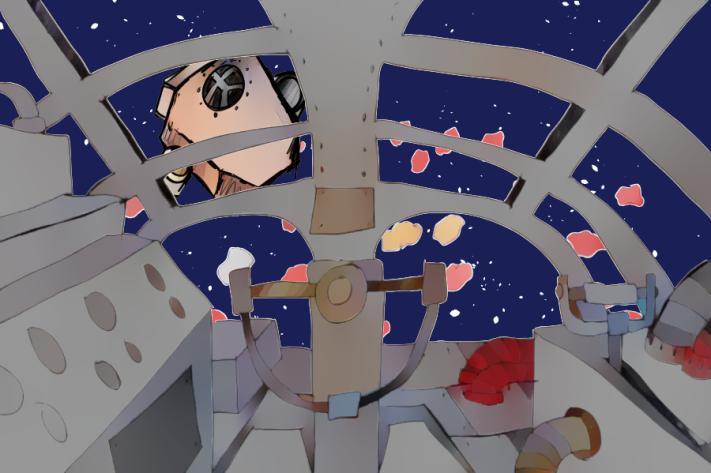
More detailed, colored imagery from "Thursday in space"

Thursday in Space involved more CSS work than our previous games. The sidebar uses Terminal with Scan Lines code created by Patrick Himes, and custom work was done for the borders and rounded edges on the buttons at the end of every passage. Code randomly set each button’s destination passage by using pluck to pull from an array of the unread passages. When every passage was removed, the button sent players to the final choice. 

There were 24 different ways to get through the story, which meant that we had to rein in combinatorial explosion by making some choices less meaningful than others. The random order also made it more difficult to test things properly. (Some players have reported that the stowaway doesn’t behave consistently, which is a bug I haven’t been able to fix.)

How it turned out

A final animated .GIF from "Thursday in space"

We accomplished a decent number of our goals.

  • Publish a game in 2023

A clear win, in line with the eternally relevant gamedev advice of making and releasing lots of small games to develop your skills. 

  • Develop mechanics that could be implemented elsewhere

Another win, using CodePen and experimenting with new ways for storylets to work together.

  • Apply novel constraints to inspire creativity

On the one hand, the Neo-Twiny jam gave us the focus that we needed to accomplish the first two goals. On the other hand, some of the choices in this story felt less meaningful than others, which the audience noticed. 

  • Reach a larger audience through the game jam community

This didn’t go so well. Sorting the jam entries by popularity puts Thursday in Space in the bottom 20% of entrants. 

Consolation prize: We realized that we could re-use assets from Project Arcmor, our game from 2021, and then we linked to it as an easter egg inside Thursday, in space

Tuesday, February 13, 2024

Game design documents: Plans come in many forms

When I was creating my first games, I didn’t think I needed to bother with design documents. 

Eventually, I realized that I was creating them anyway. I left notes for myself in various formats:
  • Comments in the code itself. It’s right there, which makes it easier to reference, but it gets distracting. The other problem is that it gets tricky to clean up comments later (unless you’re okay with distributing exasperated rants about your buggy, poorly implemented code).
  • Plans written on paper. Working in a space outside the game’s systems — especially outside of the computer — helps for visualizing problems in new ways. The tough part is maintaining the discipline necessary to convert those solutions back into digital formats.
  • Digital files. Donald and I have been doing more with Google Drive documents, and digital records are useful for copying and pasting ideas between plans and projects. The risk is that “the map is not the terrain”: It’s easy to waste time perfecting the design document instead of developing the game. 
Each format has its own strengths, which is why the broader concept of “what a Game Design Document should look like” ends up being such an amorphous glob. I have found many perspectives online:

  • What should a Game Design Document consist of and why should I write one? Thomas Steffen asks and answers this question, asserting that “Builders don’t just build, they make blueprints and follow measurements.” He also notes that the document will need to be flexible enough to accommodate changes and iterations during production. 

  • How To: Write a Game Design Document is the full Game Developer treatment from Danielle Riendeau, discussing common elements and providing examples (design documents from Grim Fandango and Deus Ex).

  • Creating a Game Design Document is Brenda Romero sharing her thinking. She writes, “There are sometimes multiple ways to do something right in the game industry.”

  • Common game design documents is a collection of archetypes put together by Max Nichols. He dismisses the idea of a monolithic, contains-every-detail-you-need design document as “a tidy fantasy.” Instead, he lists different ways that teams can communicate necessary information.

  • Game Design Document template for independent developers was created by Jason Bakker. I liked his advice to “Be thorough, but don't be absolute. Remember that everything must be allowed to change and evolve over the course of the project, and the design document is a general description more than a blueprint.” 

There are also documents online for Grand Theft Auto, Diablo, Doom, and Monaco

Ultimately, the game design document ends up taking on whatever form is most useful for the team that needs to use it. (Game design is all about testing and experimentation, which includes experimenting with the tools you use to make it easier.)

Monday, January 1, 2024

Keeping Imperfect Records

During Blaugust, I read Ocho’s post about maintaining and managing a backlog of unplayed games. It gave me some things to think about. 

I like tracking the games I’m playing for two reasons: the mindless busywork of recordkeeping is soothing when I don’t have the time or energy for actual gaming, and it helps me manage some of the more extreme mood swings that can come from beating a game. 

A lot of times, I get close to finishing a game and put it aside because I don’t want it to be over. If I’m lucky, I return and take care of unfinished business — I finally beat Inazuma Eleven and Metal Max: Xeno last year, which was rewarding. (My attempt to return to The Last Story was less successful.) 

But beating a game is like being the dog that caught the car it was chasing. I’ll be absolutely blown away by the experience for as long as the game lasts, and then I suffer an existential crisis. What am I supposed to do now that this amazing ride is over? 

That’s when the backlog helps with a list of shiny objects unplayed/unfinished games that can serve as distractions. 

Those are the theoretical benefits. But practical experience has taught me that managing my relationship with the backlog is as important as managing the list itself. If the backlog is a system for managing games, it needs to be a well-designed system that fails gracefully

I don’t need another collection of unfinished projects to feel guilty about. Instead, I should be okay with a backlog that's not completely accurate, or even one that gets abandoned. My PS2 died, and I’m not likely to see the end of Rogue Galaxy, Dark Cloud 2, Wild Arms 3, and several other games. I don't need them haunting the list as perpetual failures.

I’m playing these games to have fun, not to discharge obligationsLoosely tracking my unplayed/unfinished game backlog has been working for me, and I don’t want to turn it into an obsession. 

I think I’ll keep things unchanged in the year ahead.

Saturday, December 9, 2023

Applying and Improving 3 Types of Narrative Choices

Picture of a hand placing papers labeled "bad" and "good."

I'd like to preserve some information that’s at risk of being destroyed by capricious billionaires: Ryan Kaufman's brief list of narrative choices.

Choices to access content 

Extreme versions are just “choose ‘yes’ to continue.” (See also: Dragon Warrior’s infamous “But thou must!”) 

Less extreme versions gate off side content — something like asking the player if they would enjoy a game of chess. Kaufman noted that most players don’t get much value from choosing NOT to do something. 

Instead, these choices can become opportunities to provide an "active no" that reveals additional details about a story and its characters: 

Tweet from Ryan Kaufman that reads "Consider changing this to an active No (if you must) by reframing the choice as a role-playing moment? Choice 1: Sure, I'd love to help! Choice 2: Card tricks are demeaning to magic! This allows you to follow up on both choices with a personal or emotional reaction from NPC X."

Choices to express an opinion

I’m ambivalent about reflective choices — asking players how they feel about things — because I can’t think of any times when they improved my enjoyment of a game. Cat Manning has explained that it takes an awful lot of work to do them well

On Twitter, Kaufman also pointed out that there are risks involved:

Tweet from Ryan Kaufman that reads "The What Do You Think Question Nothing breaks immersion like the game stopping and asking the player "what do you think?" It can feel like we're breaking the 4th wall. When we want to ask the player's opinion, we have to camouflage it a bit more."

The worst abuses are authors using “how do you feel about this?” in place of “choose ‘yes’ to continue.” The story moves forward on rails regardless of how the player feels about it.

Kaufman’s recommendation was to link these choices with actual changes in the narrative, possibly adjusting the character’s inventory or abilities to reflect their answer.

Choices for a secret, third thing

My favorite segment was the choice to keep another character’s secret. This happens in Outer Worlds, where the main character has several opportunities to turn Phineas Welles over to the authorities. (That game had some problems, but choosing to reveal the location of Welles’ base had significant implications for the story and the main character’s role in it.)

Kaufman pointed out that these choices should be introduced early, because the decision to reveal a secret has more emotional weight if the player has been keeping it for a while. 

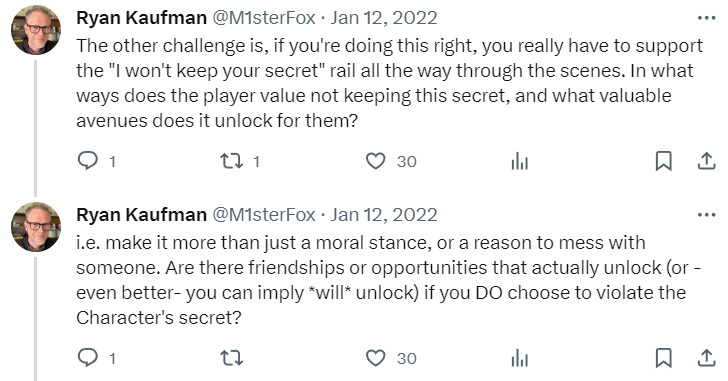
A sequence of tweets from Ryan Kaufman that read "The other challenge is, if you're doing this right, you really have to support the "I won't keep your secret" rail all the way through the scenes. In what ways does the player value not keeping this secret, and what valuable avenues does it unlock for them?" and " i.e. make it more than just a moral stance, or a reason to mess with someone. Are there friendships or opportunities that actually unlock (or -even better- you can imply *will* unlock) if you DO choose to violate the Character's secret?"

Building on these choices can add new dimensions to a narrative, especially when the different types of choices are connected. Choosing to keep a secret can lead to follow-up choices that ask how a player feels about their actions. 

Are they the type of character who will go to extreme lengths to help a friend, or will they abandon a friendship to adhere to a strict moral code? 


Saturday, November 18, 2023

Learn to Test


I used to think it was silly when shows had futuristic computers narrate what they were doing. 

You know, those little stream-of-consciousness declarations, like “scanning the area for life forms” or “initiating self-destruct sequence”? They seemed like cheap writing trying show the audience that things were happening.

Now that I have more programming experience, it makes more sense.


My early coding efforts — in Twine, so we aren’t even talking about something complicated — were nightmares of frustration filled with obscure error messages and opaque syntax warnings. Early versions of the SugarCube documentation didn’t make a lot of sense to me, and it was slow going trying to sift through Q&A pages for answers.1

It was easier to loiter in the Interactive Fiction Community Forum, where I found Linus Ã…kesson2 sharing a useful metaphor about building bridges. It's okay to start with something feeble, because you can build on it through a gradual process of refinement and evolution. 

As I beat various projects into shape — leaning on the bridge metaphor and applying McDonald’s Theory — I learned the four possible states in which code exists:


My coding efforts are still full of errors and janky syntax, but now it’s easier to find and fix the problems. If my projects need less development time, it’s not because I’m faster at coding. It’s because I’m faster at identifying where things failed. I have become better at testing. 

These improvements came from using more comments in the code and indicators that explain what's going on. When it's easier to see where things are failing, it's easier to identify where you should fix them. 

In that context, it makes more sense to have the computer announce that it’s scanning for lifeforms or initiating a self-destruct sequence.

1. I should note that Twinery.org is much more user friendly in the present day.
2. You may recognize his name from the “8-bit Baroque Metal” performance that recently took certain corners of the internet by storm.3
3. That wasn’t an intentional pun, but it works. SORRY I’M NOT SORRY.


Monday, October 23, 2023

Breathedge: The Good, the Bad, and the Awkward


I enjoyed Breathedge, but it squandered a lot of potential. The early game’s creativity and open environment became more linear and less entertaining as its story unfolded

The early survival sequence is delightful — Breathedge takes place in a massive debris field that is densely packed full of items and destinations. You have to manage hunger, thirst, and oxygen levels while collecting and crafting items that increase the time that you can spend gathering resources. You’re also working with a limited inventory space, and this is not a cozy world of abundance: All of your crafting decisions involve strategic tradeoffs to prioritize survival.

It sets up a well-managed tension in the opening chapters, leaving players to decide whether they want to spend resources customizing their own base or researching additional equipment that could help overcome environmental challenges.

Some of the most immersive, beautiful, and distracting sequences in Breathedge involved pushing to the limits of explorable space and seeing whether I brought adequate food, water, and oxygen to survive the return trip. There are enough requirements for survival, and enough new locations to explore, that it’s easy to overlook an important requirement. Then you're racing back to a previous location to grab something that was vital for survival. 

Frustration and backtracking are an intentional part of the early gameplay experience, and I enjoyed those challenges. 

Later stages are filled with pointless, mandatory backtracking — everything happens in enclosed spaces full of oxygen and additional supplies. In these sequences, you interact with a designated object that sends you to a similarly arbitrary destination in the opposite direction.

These environments felt like they were padded full of unnecessary space and deliberate switchbacks to extend the amount of time required to finish the game.

It was also disappointing to explore a universe with almost no diversity. Women only appear in Breathedge as pinup art and murals depicting idealized femininity. There’s an overall lack of variety: the humans that get rendered with faces are all men, and the majority of characters have a single, generic body type. (Granted, there are a small number of exceptions used to make fat jokes.) 

The only female voice actor in the game recites lines from a diagnostic computer with BDSM programming — she makes sexualized statements about torture and punishment in response to the player’s choices. 
Some of the poor design choices in Breathedge felt like an attempt to compensate for even worse narrative choices. The game begins with an interrogation where the player recounts their story of surviving the spaceship crash. It's a framing device where the “game over” message is replaced by an interrogator insisting that things must have gone differently. 

That kind of artifice works well in a game like Spider and Web, when the designer wants to call attention to differences between the events that happened and the story that the player sees, but it felt like a needless extra step here. The player ends up loading a saved game to continue, with or without the extra prompting from interrogators. 

Overall, it felt like the developers were reluctant to use the intrinsic motivation of survival in outer space. Instead of trusting that people would want to rescue themselves, the game imposes a confusing plot involving eco terrorists, secret research projects, and corrupt government bureaucracies. When these jumbled story pieces don’t fit together, Breathedge just breaks the fourth wall and says “do this because the designers have made it a requirement.”  

I would have been happier exploring outer space without the extra gamification.

Saturday, September 16, 2023

Tomorrow in Crabs


 “History doesn’t repeat, but it does rhyme,” as they say. 

I’ve noticed that the current fragmentation of the internet looks like the internet migrations of the early 2000s. MySpace blew up — first in the sense of getting popular, and then in the sense of complete catastrophe — which left a lot of internet users adrift.

People vowed that they would never to put all their trust in a single internet platform, and it sparked the creation of a ton of blogs. Today, people are coping with the loss of Twitter by swearing never to put their trust in a single internet platform and creating their own newsletters. 

It’s like natural selection creating 5 different evolutionary paths that all ended in crab shapes.  

But mostly I wanted to bring up crabs to note that they had a starring role in the July issue of Trends in Parasitology, a scientific journal that explores “Parasite effects on host’s trophic and isotopic niches.” The article talks about studying the different ways that parasites alter the behavior of their hosts (see also: The Last of Us). 

The article caught my attention because of this sentence: “Wild-caught organisms should not be considered single organisms, but rather entire ecosystems, hosting a variety of microbes and parasites, which can be found in virtually every tissue.”

I swear that links back to video games — I remember reading about a PC game from the 90’s where the player guides the development of a civilization that is being built in the fossilized remains of a dragon. I just can’t remember the name of it.

(The title of this post is a reference to Today in Tabs, which I’ve been using to keep up with online developments now that, you know…) 


Thursday, August 24, 2023

Questioning my reactions

 A bush in the shape of a question mark

I came of age in the internet forums of the early 2000’s, and it was a time when posters were expected to follow a forum rules — whether those rules were written or otherwise. Ignorance was no excuse, and anybody who failed to demonstrate a mastery of “obvious” common knowledge was assaulted with lurk moar memes, encouraging them to study community etiquette before posting again. 

It… wasn’t the healthiest environment for advancing collective knowledge and shared understanding?

The norms of online discourse shifted over time, especially after Twitter became a major platform. I wouldn’t use words like “welcoming” or “inclusive” to describe the average Twitter user, but it became acceptable to go around posting while ignorant on main. 

Then Dick Clark died, and ignorance had a bit of a moment. It took things to the other extreme. 

There has to be a middle ground between communities where people are pressured to hide what they don’t know and ones where people make a big show of patting themselves on the back for not knowing anything. 

Asking questions is good! It’s how a person learns, but it can also encourage inquiry and discovery among larger groups of people. Two examples come from the Interactive Fiction Community Forum:
In the current internet environment, the ability to ask questions has become much more important. News is secured behind paywalls, search results are poisoned by paid ads, and platforms like Discord make it almost impossible to find interactions from just a few months ago.

I need to reconsider how I respond to ignorance. (And to be clear, I mean honest lack-of-knowledge ignorance — I remain comfortable with my reflexive desire to spurn poorly disguised bigotry, intolerance, and hatred.)

If I’m going to “be the change I want to see” on the internet, supporting and encouraging people who want to develop new knowledge, then I’ll have to put aside the survival instincts that I developed in my early internet days. 

Sunday, August 6, 2023

I bet there’s a German word for it.

Tipa has a post up about taming the games backlog, and it’s entirely too relatable. Meanwhile, Ocho’s goals for August reminded me that I still have to get back to Fallout: New Vegas (although I’m reluctant to return after some ugly misadventures at Camp McCarran).

What I’d really like to do is resolve some unfinished business from more than a decade ago: I finally dragged my Nintendo Wii out of storage to complete some games that have been stuck in my memory for a very long time. 

What do you call it when you forget a game’s controls, meaning that you can’t pick up where you left off, but you remember too much of its plot to start over? That’s what happened with me and The Last Story.

I was barely managing the combat sequences before I took an extended absence, and now I think I'll need some time to get back into practice. Sometimes it helps to start a game over and work back through the early tutorial battles, but I don't have the patience for all the story sequences.  

Yes, I remember the island’s terrible secret. No, I don’t want to endure the extended heel turn that was heavily foreshadowed. The Last Story is interesting overall, but its storytelling can be a bit over the top. 

I’m sure that the tutorial details can be accessed through in-game menus, and I could always (pause for dramatic effect) read the manual — with enough study time, it would be possible to resume moving forward. But I don’t play games to conduct intensive research.

So I’m just kind of… staring at it? I have always wanted to see how its ends, and people say nice things about the game, which means that it’s probably worth finishing. After that, I’ll see if I can get back into Xenogears and Farewell Ruins of the Moon.

Wednesday, August 2, 2023

That's Just Science

Over at Unwinnable, they’re discussing the 2023 movie Talk to Me:

“Talk to Me may be the most credible supernatural teen horror movie ever made, simply by dint of the way that the kids in the film turn the medium-istic hand into a party game, heedless of the larger questions it raises, or the possible consequences of their actions – until it is too late and those actions have come home to roost.”

Orrin Grey, the author of the review, asserts that the movie’s credibility comes from (realistically!) showing how idiot kids will eagerly do dumb things for entertainment. 

But it’s not just kids. Over at the University of Virginia, they have known for years that people are willing to do stupid things whenever the opportunity is available:  

“For 15 minutes, the team left participants alone in a lab room in which they could push a button and shock themselves if they wanted to. The results were startling: Even though all participants had previously stated that they would pay money to avoid being shocked with electricity, 67% of men and 25% of women chose to inflict it on themselves rather than just sit there quietly and think”

More recently, Erin Kissane put it into a Mastodon-specific context:

That's part of a larger post from Kissane that discusses how and why people engage with specific social networks, which is a topic that seems relevant for Blaugust.

Tuesday, August 1, 2023

Blaugust 1: The Stressbox


Cardboard box sitting on a floor

Blaugust has me thinking about dealing with the things that stop me from blogging (i.e., writer's block), and one of the tools I use is a stressbox. It’s a mashup of two lifehacks that I found on the internet:
  • When you write down what’s bothering you, putting physical distance between yourself and the list can be like leaving your problems behind.
  • When your inner critic is particularly fierce, you can invite a second inner critic to point out shortcomings in the first critic’s attacks. (This was a joke* about tricking the two critics into arguing with each other so you could sneak off to do some real work.) 
When I can’t make any progress on a project, I create a stressbox by opening up a disposable notepad.txt file and writing out all my objections.


A few things can happen from here.

Maybe I’ll identify an underlying issue that’s stopping me from making progress. Or I could wear out my inner critic by venting until there’s nothing left to criticize. Sometimes, it’s McDonald’s Theory in action — I lay out my worst possible ideas, and then it’s much easier to improve from there. 

I also get the fun mental image of trapping my inner critic(s) in that two-dimensional prison from Superman II.


The stressbox can sound like a waste of time, but I normally bring it out when I’ve already wasted a lot of time procrastinating with things like gaming or household chores.

It’s no less constructive than any other form of procrastination, and it gets me closer to a place where I'm doing actual work. (I’m already seated at the computer and typing in complete sentences; it’s a minor change to start typing in a different window.) 

The main drawback is that the comments from the stressbox are never part of the finished work — the file is never saved, because who wants a record of their most obnoxious self-criticism? 

I end up forgetting that it can be an important part of my creative process. Every time I sit down in front of a new project, I have to remember how it works all over again. 

*Update 11/27/23: I FOUND THE JOKE!