Thursday, August 24, 2023

Questioning my reactions

 A bush in the shape of a question mark

I came of age in the internet forums of the early 2000’s, and it was a time when posters were expected to follow a forum rules — whether those rules were written or otherwise. Ignorance was no excuse, and anybody who failed to demonstrate a mastery of “obvious” common knowledge was assaulted with lurk moar memes, encouraging them to study community etiquette before posting again. 

It… wasn’t the healthiest environment for advancing collective knowledge and shared understanding?

The norms of online discourse shifted over time, especially after Twitter became a major platform. I wouldn’t use words like “welcoming” or “inclusive” to describe the average Twitter user, but it became acceptable to go around posting while ignorant on main. 

Then Dick Clark died, and ignorance had a bit of a moment. It took things to the other extreme. 

There has to be a middle ground between communities where people are pressured to hide what they don’t know and ones where people make a big show of patting themselves on the back for not knowing anything. 

Asking questions is good! It’s how a person learns, but it can also encourage inquiry and discovery among larger groups of people. Two examples come from the Interactive Fiction Community Forum:
In the current internet environment, the ability to ask questions has become much more important. News is secured behind paywalls, search results are poisoned by paid ads, and platforms like Discord make it almost impossible to find interactions from just a few months ago.

I need to reconsider how I respond to ignorance. (And to be clear, I mean honest lack-of-knowledge ignorance — I remain comfortable with my reflexive desire to spurn poorly disguised bigotry, intolerance, and hatred.)

If I’m going to “be the change I want to see” on the internet, supporting and encouraging people who want to develop new knowledge, then I’ll have to put aside the survival instincts that I developed in my early internet days. 

Sunday, August 6, 2023

I bet there’s a German word for it.

Tipa has a post up about taming the games backlog, and it’s entirely too relatable. Meanwhile, Ocho’s goals for August reminded me that I still have to get back to Fallout: New Vegas (although I’m reluctant to return after some ugly misadventures at Camp McCarran).

What I’d really like to do is resolve some unfinished business from more than a decade ago: I finally dragged my Nintendo Wii out of storage to complete some games that have been stuck in my memory for a very long time. 

What do you call it when you forget a game’s controls, meaning that you can’t pick up where you left off, but you remember too much of its plot to start over? That’s what happened with me and The Last Story.

I was barely managing the combat sequences before I took an extended absence, and now I think I'll need some time to get back into practice. Sometimes it helps to start a game over and work back through the early tutorial battles, but I don't have the patience for all the story sequences.  

Yes, I remember the island’s terrible secret. No, I don’t want to endure the extended heel turn that was heavily foreshadowed. The Last Story is interesting overall, but its storytelling can be a bit over the top. 

I’m sure that the tutorial details can be accessed through in-game menus, and I could always (pause for dramatic effect) read the manual — with enough study time, it would be possible to resume moving forward. But I don’t play games to conduct intensive research.

So I’m just kind of… staring at it? I have always wanted to see how its ends, and people say nice things about the game, which means that it’s probably worth finishing. After that, I’ll see if I can get back into Xenogears and Farewell Ruins of the Moon.

Wednesday, August 2, 2023

That's Just Science

Over at Unwinnable, they’re discussing the 2023 movie Talk to Me:

“Talk to Me may be the most credible supernatural teen horror movie ever made, simply by dint of the way that the kids in the film turn the medium-istic hand into a party game, heedless of the larger questions it raises, or the possible consequences of their actions – until it is too late and those actions have come home to roost.”

Orrin Grey, the author of the review, asserts that the movie’s credibility comes from (realistically!) showing how idiot kids will eagerly do dumb things for entertainment. 

But it’s not just kids. Over at the University of Virginia, they have known for years that people are willing to do stupid things whenever the opportunity is available:  

“For 15 minutes, the team left participants alone in a lab room in which they could push a button and shock themselves if they wanted to. The results were startling: Even though all participants had previously stated that they would pay money to avoid being shocked with electricity, 67% of men and 25% of women chose to inflict it on themselves rather than just sit there quietly and think”

More recently, Erin Kissane put it into a Mastodon-specific context:

That's part of a larger post from Kissane that discusses how and why people engage with specific social networks, which is a topic that seems relevant for Blaugust.

Tuesday, August 1, 2023

Blaugust 1: The Stressbox


Cardboard box sitting on a floor

Blaugust has me thinking about dealing with the things that stop me from blogging (i.e., writer's block), and one of the tools I use is a stressbox. It’s a mashup of two lifehacks that I found on the internet:
  • When you write down what’s bothering you, putting physical distance between yourself and the list can be like leaving your problems behind.
  • When your inner critic is particularly fierce, you can invite a second inner critic to point out shortcomings in the first critic’s attacks. (This was a joke* about tricking the two critics into arguing with each other so you could sneak off to do some real work.) 
When I can’t make any progress on a project, I create a stressbox by opening up a disposable notepad.txt file and writing out all my objections.


A few things can happen from here.

Maybe I’ll identify an underlying issue that’s stopping me from making progress. Or I could wear out my inner critic by venting until there’s nothing left to criticize. Sometimes, it’s McDonald’s Theory in action — I lay out my worst possible ideas, and then it’s much easier to improve from there. 

I also get the fun mental image of trapping my inner critic(s) in that two-dimensional prison from Superman II.


The stressbox can sound like a waste of time, but I normally bring it out when I’ve already wasted a lot of time procrastinating with things like gaming or household chores.

It’s no less constructive than any other form of procrastination, and it gets me closer to a place where I'm doing actual work. (I’m already seated at the computer and typing in complete sentences; it’s a minor change to start typing in a different window.) 

The main drawback is that the comments from the stressbox are never part of the finished work — the file is never saved, because who wants a record of their most obnoxious self-criticism? 

I end up forgetting that it can be an important part of my creative process. Every time I sit down in front of a new project, I have to remember how it works all over again. 

*Update 11/27/23: I FOUND THE JOKE!


Sunday, July 30, 2023

Blaugust: Retreating into the Future

I’m joining Blaugust this year because the internet of the future looks like a return to the internet of the past. An article in The Verge exaggerates the current situation, but not by much:

Twitter is being abandoned to bots and blue ticks. There’s the junkification of Amazon and the enshittification of TikTok. Layoffs are gutting online media. A job posting looking for an “AI editor” expects “output of 200 to 250 articles per week.” ChatGPT is being used to generate whole spam sites. Etsy is flooded with “AI-generated junk.” 

Elsewhere in The Verge, James Vincent has drawn parallels between auto-generated text and geofoam, a synthetic material stuffed into “the empty spaces that progress leaves behind.” Generative text has made it increasingly difficult to connect with people and websites that share useful information; the internet’s largest platforms have become hollow exercises in mass-produced content for monetizing web traffic. 

This decline of great powers has played out elsewhere in literature and history. Eleanor Janega sees parallels with the collapse of Twitter and the cascading failures of the Roman Empire:

In reality the “fall” wasn’t because outside forces wanted to destroy Rome – they just wanted to control it. There was a slow and steady degradation of the services that the Empire could offer, and people began to respond to this with smaller and localised communities.

Online, a shift towards smaller, more localized communities looks like a return to internet communities of the late 1990’s and early 2000’s: webrings and niche resource pages curated by passionate individuals. In the Fediverse, people are being encouraged to post more on their personal websites:

Mastodon post urging readers to return to RSS feeds, webrings, and similar interactions in the wake of major platform collapse

I found Blaugust, the Festival of Blogging, through my Mastodon account. The festival promotes a similar idea, encouraging people to publish more blog posts on their own sites during the month of August, and I’m hoping that it can help me overcome some of blogging’s emotional obstacles

(In addition to getting the idea of emotional obstacles from Tracy Durnell, I have also been thinking about her point that blog posts don’t have to be long. Both of those concepts have helped me address some of my own concerns about publishing material that doesn’t feel like it’s “good enough.”)


Sunday, May 28, 2023

Game Exploration Done Well

(Image credit: Pixabay PIX 1861)

A while back, Overthinking It discussed how players enjoy exploration and discovery in video games. The argument was that a discovery is something players learn or find. A good discovery provides a thrilling sense of accomplishment, but these discoveries are only made through the process of exploration.

From a design perspective, it’s not enough for your games to have discoveries that entertain players; the players need to enjoy — or at least tolerate — the exploration that leads to those discoveries.

Forgotten Tavern tried to apply this concept with discoverable equipment upgrades. As the story progressed, scene descriptions changed over time to encourage exploration and lead players to better equipment. (Feedback suggested that the discoveries were appreciated, but the exploration mechanics could have been improved.)

The Ultima series gives better examples of a well-executed exploration/discovery process. Jimmy Maher at The Digital Antiquarian explains

“The gratification that comes when another piece of the puzzle falls into place is considerable. Ultima has always been better at delivering that thrill of exploration than just about any other CRPG. [….]Ferreting out these secrets and hidden mechanics contributes to another thing Ultima always does well: making you feel smart.”

Maher calls it “exploration,” but finding secrets and hidden mechanics sounds more like “discovery.” This difference is noted in Andrew Plotkin’s comment on a post about Ultima IV:

“It was an exercise in detail-oriented patience. You *can* see that extra pixel if you look for it *every time*, and if you don’t — well, you’re playing the wrong game. Similarly, every NPC has something to tell you, and you plumb their stupid conversation keywords until you find it. If you haven’t seen the other side of a lake or mountain range, you’re not done with it.”

The Ultima games were designed to support exploration that led to interesting discoveries. These dynamics are also seen in a more recent game, Fit for a King. It has graphics that are clearly influenced by earlier entries in the Ultima series:

Fit for a King screenshot via Kitfox Games
(Image via Kitfox Games)

But I was delighted to learn that the similarities are more than visual. Fit for a King has 26 royal commands that are used to unearth buried treasure, yell secret phrases, and discover hidden details throughout your kingdom.

The game is described a non-linear sandbox, but Fit for a King has more structure than its description suggests: you are trying to find new ways to impress your rival before the big summit at the Field of the Cloth of Gold. It’s fun to explore the world, but it’s also rewarding to discover new and extravagant treasures that accomplish your goal.

The writing easily switches between serious and silly, depending on the circumstances. It's also brief and snarky, providing just enough detail to support the narrative.

After the preparations are ready, the player enjoys a brief exchange with their rival at the summit, and then an epilogue describes how various characters fared. That’s where you learn that the royal commands weren’t just cosmetic affordances  different characters will get married, wage war, and find lasting fame based on the player’s previous actions.

A final message encourages the player to go back and explore some more, which turns out to be a good idea. Fit for a King offers enough discoveries to support multiple playthroughs. 


Friday, January 27, 2023

Michael Crichton Predicted Our Response to ChatGPT

Dinosaur image via Pixabay

No, it wasn't in his explanation of Chaos Theory. 

It’s his description of Gell-Mann amnesia:

“You open the newspaper to an article on some subject you know well [….] You read the article and see the journalist has absolutely no understanding of either the facts or the issues. [….] you read with exasperation or amusement the multiple errors in a story, and then turn the page to national or international affairs, and read as if the rest of the newspaper was somehow more accurate about Palestine than the baloney you just read. You turn the page, and forget what you know.”

Most of the breathless hype about ChatGPT seems to come from people asserting that it will radically disrupt the work of someone else. When experts evaluate ChatGPT in their own disciplines, the same optimism is missing:

  • Musician Nick Cave has received “dozens” of ChatGPT-created songs that attempt to emulate his work. He is not impressed.

  • Stack Overflow, a website for programmers discussing code, found ChatGPT answers to be “substantially harmful” (emphasized in the original statement) for users who want correct information.

  • Journalists at Futurism looked at CNET's use of ChatGPT for creating news stories, and they found “a series of boneheaded errors.” 

  • In cybersecurity discussions, observers have pointed out that ChatGPT can’t do the actual work required for a successful attack. 

  • One app tried using ChatGPT responses in its online mental health services, and the experiment ended because “messages just felt better” when they were written by humans. 

When it comes to overblown predictions about ChatGPT’s effects, it’s odd to see credible sources change gears and forget what they know. At least Michael Crichton can explain what’s happening. 

TL;DR Just invoke Betteridge’s law when an article asks you “Can ChatGPT fill in mentorship gaps for Gen Z workers?

Friday, January 13, 2023

The Perils of Narrative Dissonance

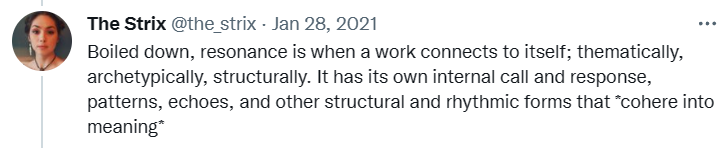
I wrote a public review of Potion Permit — it’s up at Press SPACE to Jump — but the lack of narrative resonance in the game deserves a discussion of its own.

Tweet from @the_strix: "Boiled down, resonance is when a work connects to itself; thematically, archetypically, structurally. It has its own internal call and response, patterns, echoes, and other structural and rhythmic forms that *cohere into meaning*

Stardew Valley, the Rune Factory series, and Story of Seasons games all resonate with the idea of nurturing. They ask you to spend time and attention on short activities for long-term benefit, nurturing crops and relationships that yield rewards.

Potion Permit abandons the ideas of farming and growth. Instead, you run an infirmary to heal sick patients. You brew potions for healing, and your ingredients are gathered outside of town. 

The potions, and their constant demand for ingredients, turn every day into an extractive rampage. The only limits are your own endurance. The exact same objects will appear in the exact same places the following day, so take everything you can find!

Potion Permit screenshot showing tree stumps and crushed rocks.
Success is full of tree stumps, crushed rocks, and cut plants.

You can pretend to be a careful ecologist by taking only what you need, but the game mechanics completely ignore any suggestion of an ecological balance. There’s no penalty for stockpiling absurd amounts of raw materials, and you’ll probably need them later. 

This extractive idea of “harvesting” clashes with the story behind your mission to Moonbury: the player is supposed to heal a long-standing rift between the Medical Association and the local villagers. (The association was exiled after a series of mysterious accidents wiped out native plants that were unique to the area around town.)

Spoiler alert: the conflict turns out to be a big misunderstanding. Chemists didn’t cause these problems, but their knowledge can fix them. The ecological disaster sites end up being excuses to brew Potion X and apply it at Location Y. 

Once the native plants are restored, they're additional resources to extract for your potions. It doesn’t feel like a story about healing environmental damage when the gameplay has you unlocking new areas for exploitation.

All this activity is completely removed from the social dynamics of Moonbury and its inhabitants. In fact, they encourage you to extract additional resources to experience the next installment of their story. Getting to know villagers through daily interactions becomes the thing you do to find out what needs to be extracted next.  

Tweet from @the_strix: "So what are the tools of narrative design resonance? Theme is your strongest ally. Know your themes, know how they translate to mechanics. Thematic patterns echoing in parallel, or like nesting dolls. Characters illustrating themes or challenging them."

Potion Permit ends up feeling like a narrative of colonization and imperial expansion. The capital city, and its bureaucratic medical association, has sent the player to a backwards society that relies on a witch doctor. You are asked to improve that society by looting the surrounding landscape, saving the people from themselves.

I don’t think this colonization theme was intentional! But it’s an interpretation that fits into the spaces left by disjointed narrative design. 


Saturday, October 8, 2022

Blood Island: IFcomp 2022

Blood Island is a choice-based IFcomp 2022 entry by Billy Krolick that describes itself as a “philosophical Dating Sim turned Slasher.” 

Blood Island strikes an interesting spot at the intersection between reality shows and self-aware slasher films. They both involve performances from actors who intend to be observed, and this work was an opportunity to ask readers how their own performances might change in the presence of an audience. 

However, it might have been helpful to let the readers ask that question themselves. This Choicescript story interrogates readers after almost every passage.
 
How do you feel about reality shows?
How do you feel about slasher movies? 
How do you feel about Final Girl Theory? 

Blood Island asked me how I felt about things so frequently that I never had a chance to develop those feelings. The topics switched so rapidly from concepts outside the story to dynamics within the narrative that I was left on uncertain footing. 

I couldn't tell whether I was supposed to answer these questions as a character or as the player controlling that character, which left me over-thinking everything: did I need to avoid a killer, or did I need to avoid a killer who was constrained by the rules of slasher films, or did I need to pay less attention to reflective choices so that I could get further into the story?

My obsession with giving the “right” answers prevented me from enjoying the descriptions, which were howlingly funny in several places. 


I enjoyed the concept, and I had fun with the atmosphere, but the overall implementation was… questionable.

(I’ll see myself out.)

Friday, October 7, 2022

Headights: IFcomp 2022

Headlights is a parser-based work by Jordan White entered into IFcomp 2022. It was created with Perplexity

The action in Headlights consists of looking at everything to find items that can open new locations. It relies on an artificial sense of urgency, continually telling players to hurry, that is not supported by any gameplay mechanics. Mostly, these reminders drew my attention to the lag between typing a command and receiving a response. 

There’s no real “search” command with Perplexity — an object’s notable features are revealed when you look at it. The default state of objects involves less description, which led to an infuriating encounter with “a bush, a bush, and a tree.” (You couldn’t look directly at either bush, because the parser didn’t understand which bush you wanted to check, but “look at bushes” eventually revealed that each bush had its own identifying adjective.)  

Overall, Headlights felt more focused than Kidney Kwest, the last Perplexity game I encountered. Most of the experience involved looking at objects and applying them logically to move to the next location. I particularly enjoyed the puzzle that involved a surge of adrenaline, because it did an unusually good job of using a narrative to justify the following sequence of events. 

Headlights worked smoothly when the parser and I stuck to clear language and simple concepts, which raises interesting questions about the future of Perplexity as a game design tool. Creations like Lost Pig, Vain Empires, and Zozzled are entertaining because they play with unconventional language and abstract concepts, and it may be difficult for Perplexity to enjoy similar success.


Thursday, October 6, 2022

To Persist/Exist/Endure, Press 1: IFcomp 2022

To Persist/Exist/Endure, Press 1 is a choice-based work of fiction created for IFcomp 2022 by Anthony O. 

This entry was small and polished. It was created with Texture, and it involves moving verbs from the bottom of passages onto highlighted words above. Most of the action involves selecting options from phone menus, but a few choices offer glimpses into an existence outside of the automated call center script. 

This work was entertaining and responsive, and I particularly appreciated how hovertext confirmed my intended choices before I executed them. (When I tried playing it on a phone, it was very helpful to see whether I had moved to the right spot in the itemized lists.) 

I also liked the options that were available, including the choice to continue in Polish. The main menu suggested some interesting possibilities, and it found creative ways to redirect players back to the central set of choices. I kept hoping to find out more about monsters under the bed, but I might not have been clever enough to make the right selections. 

To Persist/Exist/Endure, Press 1 could be an interesting component in a larger work of interactive fiction. I enjoyed exploring it, but I was ultimately frustrated by my inability to make any material changes in the main character’s circumstances. 


Wednesday, October 5, 2022

The Hidden King's Tomb: IFcomp 2022


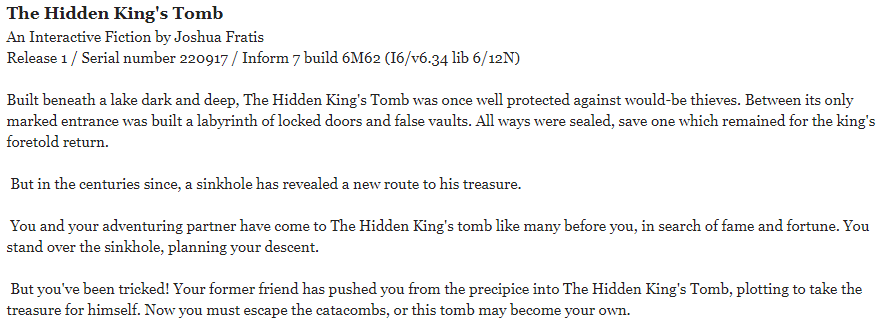
The Hidden King’s Tomb is a parser-based entry submitted to IFcomp 2022 by Joshua Fratis. 

As a text adventure, this entry covers all the bases. The Hidden King’s Tomb has treasures to collect, puzzles to unlock, and secret rooms to reveal. It’s a functional scavenger hunt — game historians have already chronicled how the earliest text adventures were scavenger hunts, so this entry continues a fine tradition. 

However, many of the early text adventures had extrinsic motivation that broke the fourth wall to let audiences know when they were making progress. The Hidden King’s Tomb downplays these game-like aspects to leave players alone with their intrinsic motivations. If you don’t want to find out more about the Hidden King and the events that led him to bury his secrets beneath “a lake dark and deep,” then there’s little reason to enjoy your exploration. 

The classic phrase describes interactive fiction as a narrative at war with a crossword, and I would have enjoyed seeing more of the narrative that created these puzzles. I found very little backstory about the king, his queen, or other figures within the tomb. Many of the locations were richly described, but their descriptions fell flat when I tried to examine objects and features that weren’t implemented. 

The introduction mentions “a labyrinth of locked doors and false vaults,” but I only found one locked door. The gameplay might have involved a labyrinth, but that might have been an issue with my own reading comprehension; I found it difficult to identify how different locations related to each other. 

Despite my complaints about The Hidden King’s Tomb, I still managed to blunder my way to freedom. It was smoothly implemented, and I would have appreciated a chance to explore further.

Sunday, October 2, 2022

Use Your Psychic Powers at Applebee's: IFcomp 2022


Use Your Psychic Powers at Applebee's is a choice-based comedy by Geoffrey Golden that was entered into IFcomp 2022. 

This entry quickly establishes the stakes involved: the success of your next Zoom meeting with corporate depends on your ability to push Schtupmeister beer on a restaurant full of unsuspecting marks. It delivers an entertainingly goofy night on the job.

There are five different narrative threads that you can focus on, using either your psychic powers or more mundane observational skills. The key is to intervene at precisely the right moment, and spending too long with any one story risks missing a key moment elsewhere. 

I really enjoyed the tone of this entry, which fully embraced the absurdist corporate marketing deployed by retail food and beverage companies, describing edible horrors like Sriracha whipped cream that sounded just plausible enough to exist. 

It’s all delivered with a cheerfully sociopathic indifference: 

But it’s also worth noting that this entry, which asks you to engage in guerilla marketing to promote Schtupmeister beer, feels like its own work of guerilla marketing to promote the Adventure Snack Newsletter

And that’s fine! I honestly enjoyed reading through this story several times to explore each narrative thread and the ways that they could be pushed to interact with each other. 

Lord knows that there have been stunt entries in previous years that weren’t nearly as entertaining. 


No One Else Is Doing This: IFcomp 2022

No One Else Is Doing This is a choice-based community organizing simulator by Lauren O'Donoghue that was submitted to IFcomp 2022. It uses a second-person perspective to burden you with the task of going out on a Friday night and collecting £5 in dues for a community union. 

This entry is well written and smoothly implemented, combining large themes and small details to wrap the entire story in an overwhelming sense of futility. You are clearly not part of the community that you visit, located “in a ward the other side of the city from your own home,” and the union keeps itself at a distance, working through an authority figure that keeps encouraging you to collect money.

There are 32 houses that you can visit, and each one is experiencing its own problems. Even if you take notes and focus on the houses that are most likely to pay dues, the text continually questions your choices and doubts your impact. (Are you willing to encourage a bigot's prejudiced rant if it helps you meet your quota?) 

You also have to manage your own needs, because the shift ends early if you get too cold or ignore the fact that you need a bathroom break. You can goof off by reading news headlines and texting your colleagues, but their lack of commitment makes your own dedication seem even more pointless. 

I particularly appreciated the “glossary” in No One Else Is Doing This. It felt like the basic information that this faceless organization would provide to new volunteers, telling them just enough to get them started.

This entry ended so abruptly that I restarted it without noticing, and that appears to be an intentional design choice that drives home the futility of your efforts. 

If you aren’t going to do the work, somebody else might. And if nobody does it, will anyone notice? 

Chase the Sun: IFcomp 2022


Chase the Sun is a choice-based entry for IFcomp 2022 created by Frankie Kavakich.

This entry might be the depressing story of a person who gives up in the face of an unstoppable disaster. It could also be an encouraging connection between two people at the end of the world. (And it might have been an attempt to create a meta-narrative about persistence in the face of adversity? I thought that there was no way to avoid bleak destruction, but I kept trying options until I found something positive.)

Chase the Sun puts a lot of effort into establishing a specific atmosphere with its early passages:

 “Pennsylvania is known for its winding, aimless back roads like it was known for its abandoned coal mines and its flirtatious relationship with religion. That is to say, only the locals know the grimy, dirty truths.” 

It says exactly where you are and how the protagonist feels about it, presenting a consistent, richly described world that holds up across several readings. I appreciated how statements that seemed odd or out of place in the early passages were explained elsewhere in the story.

On the other hand, it would have been helpful if the story mechanics had received a similar level of attention. This work was created in Texture, and it asks readers to drag words from the bottom of a passage to connect them with highlighted points in the text above. In theory, Texture enables new types of interactivity. In practice, a lot of that potential went unused in Chase the Sun. 

From a game design standpoint, there’s almost no difference between passages that end with “click to continue” and passages that end with a single verb to be moved onto a single highlighted noun.* Chase the Sun had both types of passages and some other design compromises that felt more like awkward attempts to deliver additional backstory and less like a valid method of reader participation.

My overall impression was that stronger editorial choices or conscious design changes could have improved this story’s focus — there were a few satisfying combinations of words that moved the story forward, but it made the other sections feel under-developed. 

It’s a solid work of fiction that would benefit from some improvements to the user experience.

*You could argue that dragging words around makes the reader actively participate in the suffering of this protagonist, but the 2018 IFcomp entry Bogeyman did a fine job of exploring complicity and torment without an interface like Texture.

Friday, September 23, 2022

Narrascope 2022: Designing Authentic Choices

Narrascope 2022 was an event organized for people to exchange ideas around narrative games, and it took place on July 30–31. The recordings are available on YouTube

For her Narrascope 2022 presentation, Hélène Sellier discussed how she approached the challenge of creating authentic choices for difficult situations:

 
Sellier and her colleagues at The Seed Crew wanted to design a narrative that provided more nuanced choices than simple options to “accept” or “reject.” This led them to examine the cognitive emotional, behavioral, and somatic reactions to events that are perceived as painful, worrying, or threatening. 

Research by Richard Lazarus and Susan Folkman provided a starting point by identifying two main styles of coping: active and passive. 

“The active coping strategy consists in controlling or modifying the situation by taking action on what causes stress,” Sellier said, and “passive coping strategies consist in denying or avoiding the origin of the problem and diverting our attention somewhere else.” 

These ideas make it easier to keep an audience engaged with a narrative — by shifting the framing from accept/reject to active/passive, people can choose how to respond, but none of their choices provide an opportunity to completely reject the situation. 

Within this new frame, Sellier and her colleagues also wanted to provide a wider range of choices. Ideally, their narrative would offer three to five options, but they also wanted to avoid implying that some choices were morally better or worse than the others. 

Sellier explained that Jakobson’s functions of language ultimately provided a way to create a larger range of dialogue options that still felt authentic. Sorting Jakobson’s six functions into active and passive responses created four final options: passionate, rational, conciliatory, and flippant. 

The result is a set of categories that apply to a broader range of narrative situations. “We wanted the model to become compatible with neutral events,” Sellier said. “We do not want to single out discriminatory situations from other moments of the story.” 

Seed Crew applied this framework to RecovR, an episodic narrative game that addresses diversity and inclusion issues like sexism, ableism, and racism. They have chosen a difficult task in trying ot create choices that feel authentic for these situations, but their work is grounded in published research and thoughtful approaches to game design. 

Wednesday, August 31, 2022

Narrascope: Chess and Narrative Depth

Narrascope 2022 was an event organized for people to exchange ideas around narrative games, and it took place on July 30–31. The recordings are viewable on YouTube.

I watched Nessa Cannon’s Narrascope presentation, “Using chess as a metaphor in game narrative.” The title accurately summarizes its contents:


Cannon drew on her background — someone who started playing chess at the age of 3, and who later worked as a chess coach — to discuss how the game and its pieces have been accumulating symbolic meaning for centuries. This means that the symbolism of chess can easily be integrated with other thematic elements, and Cannon identified three ways of involving chess in storytelling:

  • Overt chess inconography. The example that Cannon gave was the character from Phoenix Wright: Ace Attorney whose office includes a chessboard. It’s a prop to make them look smart.

  • Characters representing specific chess pieces, which is something I have seen in The Avengers: it’s a pair of characters named “Knight” and “Steed” who work for a higher authority and foil the plots of diabolical villains.

  • “Chessboard subtext,” where story elements reflect the interactions of chess pieces on a board. This rarely happens on its own; authors often include one of the other approaches to call attention to the subtext.

It turns out that there are more possible variations of chess games than there are atoms in the observable universe, which means that dedicated enthusiasts will find historical matches or sequences of moves that fit almost any story. 

This symbolism moves in either direction: writers can start with a chess game and develop it into a story, or enrich an existing story by drawing parallels with chess strategies. Weak stories can also benefit from chess allusions to appear more fully developed. And when I say “weak stories,” I specifically mean Kingdom Hearts III. 


Cannon brought up Kingdom Hearts III during her talk to note that it opens with two characters playing chess. “Seeing this, like, in the very beginning of the game, shows a lot of how methodical these characters’ plans are.” She pointed out that it suggests “there’s a long game going on, and the people have been planning this for a really long time.” 

I support that interpretation, but I’m reluctant to say that the subtext is applied consistently throughout Kingdom Hearts III. The overall plot is a barely functional pile of excuses — the entire franchise exists solely to escort players through experiences with various Disney properties. 

(And that’s fine! I had a lot of fun re-enacting Disney moments while smacking monsters with a giant key. It’s entertaining, but I would not hold this series aloft as a triumph of narrative elegance.) 

The good guys in Kingdom Hearts III win every time, and there are only so many ways to maintain dramatic tension in that situation. The idea of a grand strategy is invoked to claim that you were supposed to foil evil plans at Location A, that it was a ruse to draw you away from something sneaky happening in Location B.  

But this ultimately proves Cannon’s point about chess being a way to enrich narrative experiences. "It's really powerful," she said. "I think that it's really under-utilized." 

For intricate stories, the inclusion of chess metaphors can add extra depth. For shallow stories, chess imagery can disguise the lack of a coherent narrative. 

In Cannon's words, "It'll add a layer to your game that might not have been there before."


Sunday, July 31, 2022

Alliance Alive, Gameplay Successes, and Storytelling Failures

I have been enjoying Alliance Alive recently. The combat system feels like big improvements over SaGa Frontier and even Legend of Legacy, but the storytelling component needs some help.

There’s a lot going on! It has unique characters, distinct cultures, and world-altering conspiracies, but it feels like everything interesting happens off camera. My characters always felt like they were racing to hear about a story that happened somewhere else. 

This game originally hyped its connections to Suikoden, and I'll admit that it has improved on some aspects of that series over the past (checks notes) you know what? Never mind how long it’s been. 

The combat system is nuanced and rewarding. Every character can use every skill, and their abilities improve when they get used more frequently. It’s more than just picking fight off a menu or working towards an arbitrary EXP goal; you are encouraged to make thoughtful choices about the roles that you want each party member to perform.   

Your characters also build skills faster when the stakes are higher, which actively encourages players to seek out more powerful enemies and hunt rare monsters. As a whole, the system works to deliver victories that feel more meaningful, making it less like grinding and more like seeking out new challenges for sharpening skills.

However, the base building felt like a giant step backwards. You literally built bases, placing identical structures in interchangeable locations on the map, but they had no effect on the story. In Suikoden, new recruits unlocked new areas of your castle and opened up different functions in the game. In Alliance Alive, you just fill a bunch of empty rooms with NPCs who have a single line of dialogue. 

The entire story felt like a sequence of empty locations waiting to be populated with something interesting. NPCs traded speech bubbles with the lead character on the screen, and different members of the party had their own personalities — serious, silly, inquisitive, or wary — but it was rarely reflected in their surroundings.

It’s the opposite of the storytelling that you see in a game like Dragon Quest XI. Those stories force the player to use specific characters at different points of the game so that they can explore an environment that reflects their struggles. (Think of Erik confronting his own greed as he explores the fortress made of solid gold, or Sylvandro leading his post-apocalypse parade into a town that’s plagued by a dancing curse.) 

Any member of the party can take the lead in Alliance Alive, which means that each location has to support several different interpretations. Is the player leading a quest for vengeance? A mission of scientific inquiry? A race to recover lost artifacts? There are so many possibilities that the designers can’t commit to any specific emotions. Everything is presented with an identically accommodating blandness. 

I second-guessed a lot of my story choices, trying to figure out whether I was supposed to experience exchanges as something serious, funny, sad, or silly. I kept asking whether it would play better with different lead characters. And then I wasted a lot of time re-loading different scenes to find out that it didn’t. 

The big cutscenes weren’t much better. There were so many characters in each sequence that none of them ended up being memorable. Marketers have a cliché that describes this phenomenon: when you try to appeal to everyone, you appeal to no one.

It ended up being like the paradox of immersive gaming: you have to remind the player that they’re in a game if they want to feel like they’re making choices that matter. In this case, if Alliance Alive told more narrowly focused stories, its world might have felt more expansive.

Saturday, October 16, 2021

Grandma Bethlinda's Remarkable Egg: IFcomp 2021

Grandma Bethlinda's Remarkable Egg is a parser-based marvel created by Arthur DiBianca. The egg is a marvelous toy, both as an in-game object and as an entry in IFcomp 2021.

I really enjoyed the way that this work combined strong writing with strong coding. You might think that you want to pick things up, move to different locations, or interact with a bigger world through the parser, but the story provides elegant distractions to explain why you won’t be doing any of those things.

Grandma Bethlinda's Remarkable Egg has discarded a lot of familiar parser actions in favor of custom commands. There’s supposed to be a manual that explains how everything works, but… you’ll find out for yourself in short order. Meanwhile, the new commands introduce persistent changes into the environment that interact with each other in unexpected ways.

I thought this entry hit the sweet spot between creating challenges for the programmer and delivering enjoyable experiences for the player. Other entries have fallen flat when authors experimented with technical challenges instead of making design choices that support the story, but Grandma Bethlinda's Remarkable Egg seamlessly integrates its story and its mechanics with playful explanations.

It was a lot of fun.

Friday, October 15, 2021

RetroCON 2021: IFcomp 2021

RetroCON 2021 is a choice-based work by Sir Slice that was entered into IFcomp 2021.

The blurb for this entry encapsulates its entire story: the player is at a retro gaming convention in Las Vegas. Although the convention lasts for 2 “days,” you have as much time as you want to explore everything.

This entry has pulled off some feats of programming that are far beyond my own Twine capabilities. You can play 3 different games at the convention and gamble on 4 different games in the casino. Each of the 7 options presents a mini-game in its own right, including one that is a functional parser experience.

RetroCON 2021 was a little disorienting — the over-arching message of IFcomp is “come and enjoy this group of games,” so it gets weird and recursive to find the same message inside an IFcomp entry.

It reminds me of Jeff Goldblum’s line from Jurassic Park.

RetroCon 2021 works as a proof of concept, but I would have enjoyed a narrative arc that offered more than arriving at a location and leaving when I got bored.

To be fair, engaging narratives are difficult to implement! Especially when you’re making a game about playing other games. It took a lot of work to build RetroCon2021, and that deserves to be recognized.